 Visit Turkey
 Visit Vietnam
 Visit Cambodia
 Visit Dubai
 Visit Jordan


 English
 Dutch
Dutch Japanese
 Korean
 Chinese
Top Activities: Things to Do in Turkey in 2026 and 2027
Discover the top things to do in Turkey in 2026, from historical sites to natural wonders. With so much to explore, there is something for everyone.



Anıtkabir is the monumental hilltop complex in Ankara that serves as the final resting place of Mustafa Kemal Atatürk, the founder and first President of the Republic of Turkey. More than a mausoleum, it is a carefully choreographed landscape of memory, an ensemble of avenues, towers, courtyards, sculptures, and gardens designed to communicate the ideals that shaped modern Türkiye. Set in the central Çankaya district on the ridge known historically as Rasattepe, Anıtkabir anchors the capital’s skyline and functions as a civic stage for national remembrance.
For travelers, Anıtkabir blends architecture, art, and landscape with a moving museum experience. For citizens, it is a place of ritual, from daily guard duties to vast public gatherings on national days. This guide brings together the essential background, practical tips, and insider context to help you understand and experience Anıtkabir with the depth it deserves.
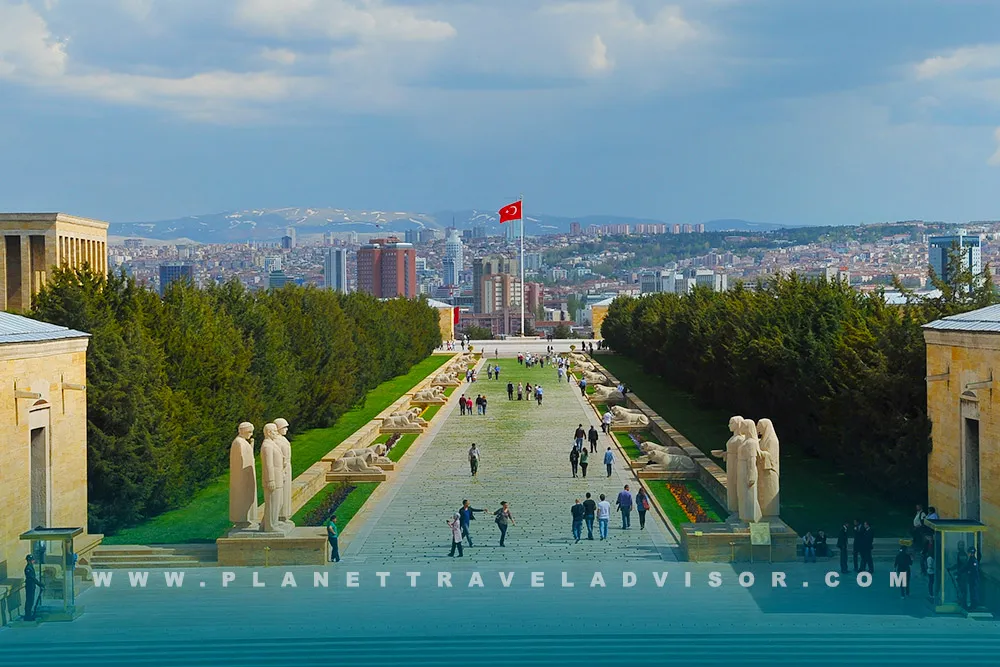
The design of Anıtkabir emerged from an international architectural competition won by Turkish architects Prof. Emin Onat and Orhan Arda in the early 1940s. Construction began in 1944 and concluded in 1953, culminating in the transfer of Atatürk’s remains to the Hall of Honor on November 10, 1953, the 15th anniversary of his death. The complex occupies roughly 750,000 square meters, divided into the Monument Block and the surrounding Peace Park, a sweeping green belt planted with tens of thousands of trees.
The ensemble includes the approach known as the Road of Lions, the vast Ceremonial Plaza, the temple-like Hall of Honor where the symbolic sarcophagus stands, a series of thematic towers, and the Atatürk and War of Independence Museum beneath the mausoleum. Each element has a clear symbolic purpose and is aligned along an axial route that builds anticipation and solemnity as you progress toward the tomb.
Following Atatürk’s death on November 10, 1938, his body was placed temporarily in the Ankara Ethnography Museum while the state advanced plans for a permanent mausoleum. After the 1941 competition and site selection on Rasattepe, ground was broken in 1944. The build unfolded in four stages over nine years, with foundation redesigns to ensure long-term stability. The project finished on September 1, 1953, and Atatürk’s remains were brought to Anıtkabir in a state ceremony on November 10, 1953.
The phased construction strategy, retaining walls and earthworks, then the surrounding buildings, followed by the monumental approaches, and finally the finishing stonework, allowed the team to adapt to engineering challenges while preserving the architectural intent. Today’s visitor route still mirrors this logic: a long, symbolic approach culminating in the interior sanctum.
Anıtkabir belongs to the Second National Architecture movement in Türkiye, blending modern monumentality with historical references to Anatolian civilizations as well as Seljuk and Ottoman forms. Materials are primarily reinforced concrete sheathed in travertine and marble. The result is a restrained, dignified expression, severe in outline yet rich in crafted details, from reliefs and mosaics to inscriptions of Atatürk’s words.
Ten flanking towers punctuate the complex, each representing ideals linked to the republic: Independence, Freedom, Victory, Peace, and more. Inside, motifs echo kilim patterns in fresco, and reliefs depict mythic symbols such as the eagle or scenes of citizen-soldiers leaving for the front. These narrative spaces help visitors read the site’s themes even before entering the Ceremonial Plaza.
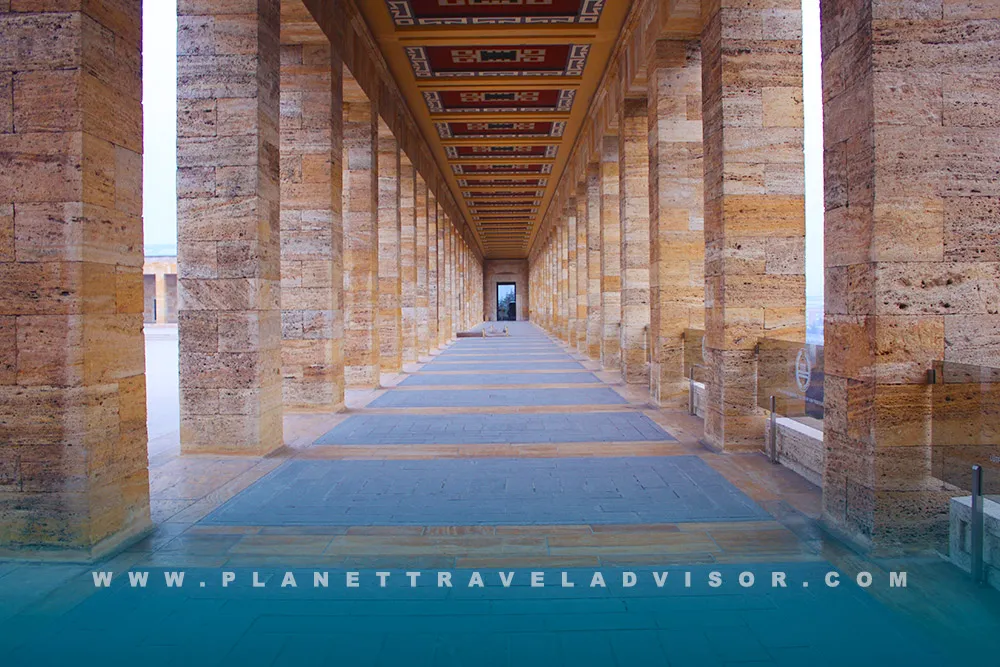
The overall composition is designed to slow the visitor’s pace and heighten reflection: the measured rhythm of colonnades, the scale of the plaza, and the ascent of the grand stair intensify the moment when the Hall of Honor finally commands your view. The language is monumental but deliberately human in its procession.
Official state ceremonies occur at Anıtkabir on national holidays and every year on November 10, the anniversary of Atatürk’s death. The November 10 observance is particularly powerful: the country pauses for a moment of silence at 09:05, and crowds stream to the plaza throughout the day. Heads of state and foreign delegations also lay wreaths at Anıtkabir during official visits, underscoring its diplomatic as well as domestic significance.
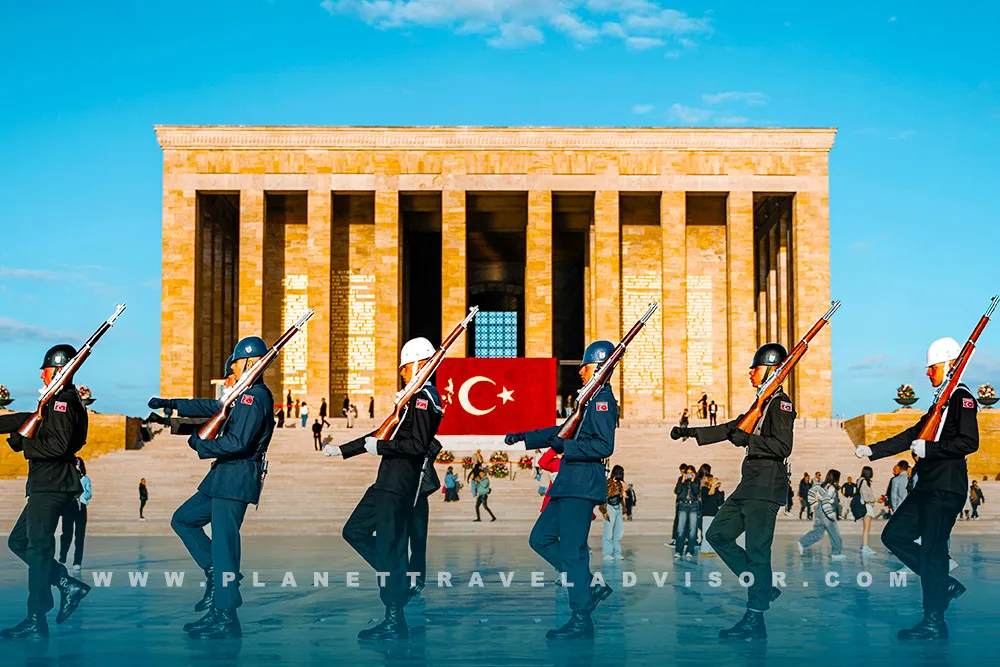
The changing of the guard is a solemn daily routine. While exact times can vary, many visitors observe it around the hour during the day, a precise, highly disciplined ceremony that underscores the site’s military custodianship. Guards are rigorously selected and trained for the duty, and on days of major ceremonies, the number of posted guards increases.
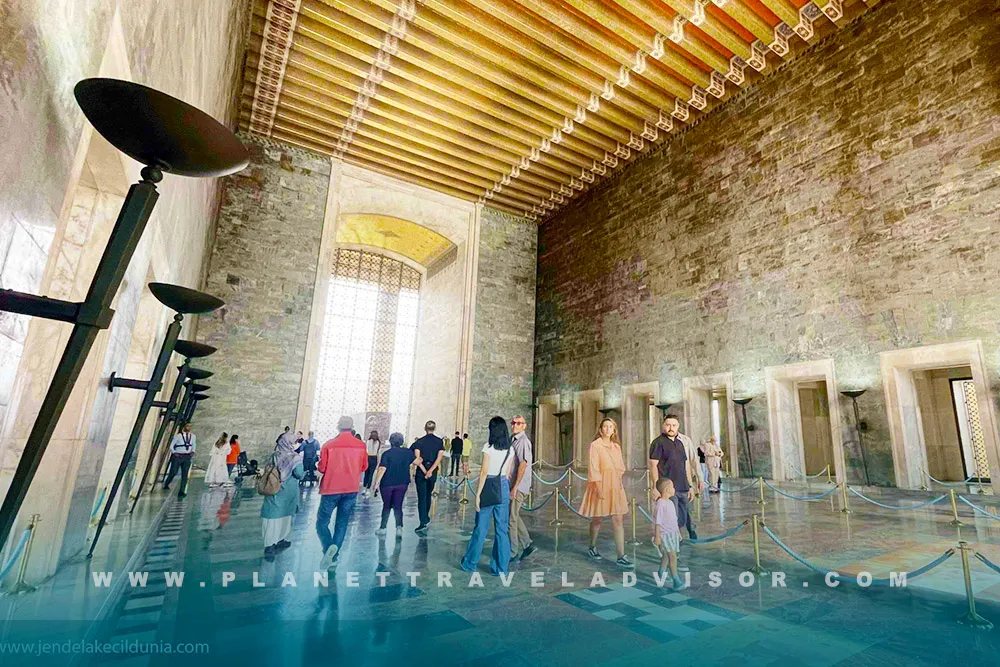
Beneath the Hall of Honor, you’ll find the Atatürk and War of Independence Museum, one of Ankara’s most illuminating collections on the late Ottoman period, the Turkish War of Independence, and the founding years of the republic. Exhibits include Atatürk’s personal belongings and library, official gifts, period documents, and immersive diorama panoramas that narrate key battles and diplomatic milestones. The core museum opened in 1960 and was significantly expanded and reinterpreted in 2002 under its current name.
Plan extra time for the galleries: the interpretive displays reward unhurried reading, and the material culture on show, from uniforms and photographs to original manuscripts, helps ground the abstract ideals of the site in concrete lives and decisions.
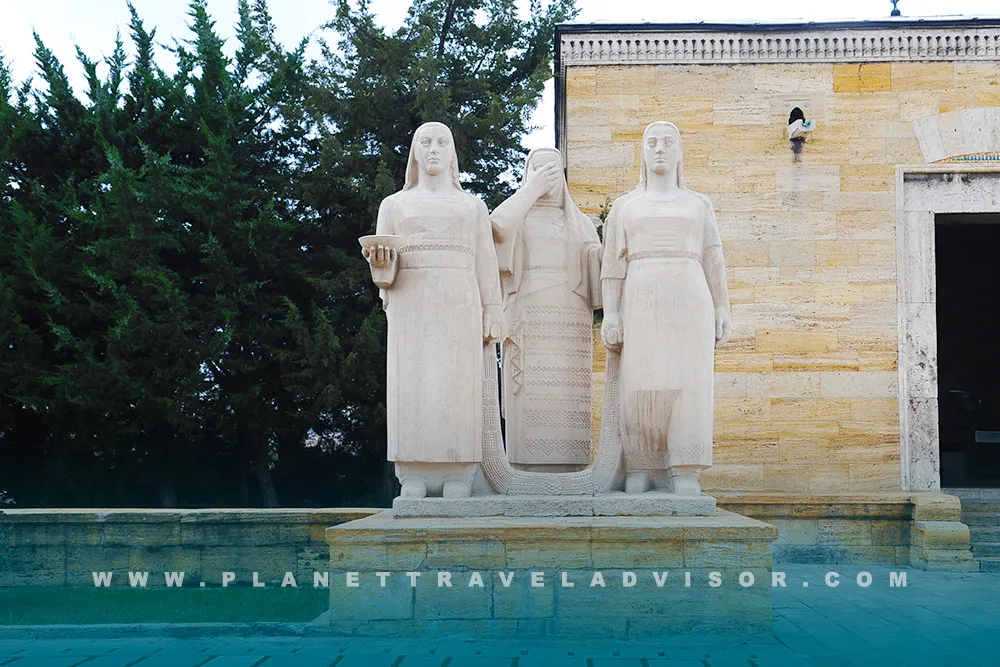
To experience the site’s narrative as intended, begin at the lower entrance and follow the full symbolic procession:
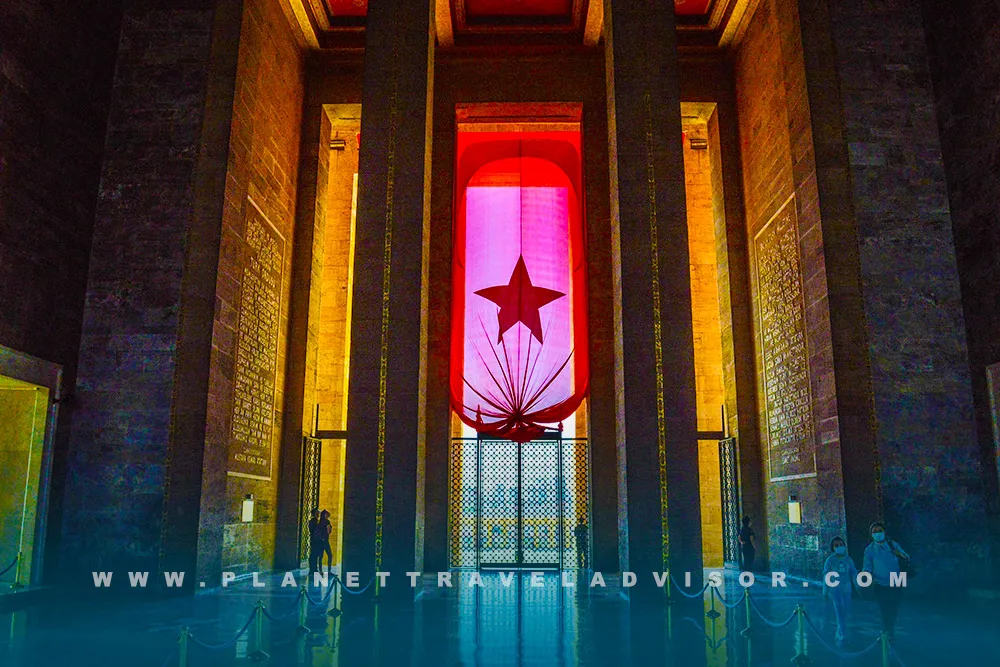
Mornings on ordinary weekdays are the calmest and best time to visit. If you’re visiting on October 29 (Republic Day) or November 10, plan for very large crowds and road closures; arrive early, follow security guidance, and expect queues at the museum. During peak times, consider enjoying the Peace Park first and returning to the Hall of Honor closer to closing when day-trippers thin out.
To witness the changing of the guard, position yourself along the processional path near the plaza. Visitor accounts frequently note hourly rotations, but schedules can adjust for ceremonies; asking on arrival or checking the day’s notices is the most reliable tactic.
Photography is generally commonplace outdoors, but always respect signage and staff guidance, especially near the Hall of Honor and during the guard ceremony. Drones are not appropriate. Tripods and professional rigs may be restricted, and you should avoid obstructing the flow of visitors for photos. Keep your phone silent and step aside if you need to take a call.{index=32}
Dress comfortably yet modestly, carry water in warmer months, and wear non-slip shoes in case of rain (the travertine can be slick). If you’re traveling with children, consider breaking up the visit: begin with the lions and plaza to capture attention, pause for a snack in the Peace Park, then save the museum for last when everyone is ready for a quieter, indoor focus.{index=33}
Anıtkabir in Ankara is the monumental mausoleum of Mustafa Kemal Atatürk, blending powerful architecture, symbolism, and landscape into a national place of memory, where visitors walk the Road of Lions, explore the vast Ceremonial Plaza, and reflect in the Hall of Honor and Peace Park.
Visiting Anıtkabir is often part of wider Turkey packages that take you beyond Ankara to explore Istanbul’s timeless landmarks, Cappadocia’s fairy chimneys, Pamukkale’s white terraces, and the ancient city of Ephesus, bringing together the country’s rich history, culture, and natural beauty in one unforgettable journey.


A curated list of the most popular travel packages based on different destinations.
Discover the top things to do in Turkey in 2026, from historical sites to natural wonders. With so much to explore, there is something for everyone.
The best time to visit Turkey 2026 depends on what you're looking for. Read more about when to go to Turkey 2026
Plan your perfect Istanbul trip with our guide! Discover top attractions, local cuisine, and tips for an unforgettable adventure in this vibrant city.
Get the ultimate Istanbul packing list for your 2026 trip. From clothes to essentials, be fully prepared for a memorable visit to Turkey’s vibrant city.
Discover the worst seasons to visit Konya. Learn what to expect year-round and get tips to plan your trip and enjoy Konya’s culture and history wisely.
Discover top tips for visiting Konya, Turkey! Get advice on culture, safety, attractions, and food for an unforgettable experience in this historic city.
Get ready for Konya with our packing guide covering essentials, toiletries, tech, and smart tips for a smooth and culture-rich travel experience.
Plan a perfect visit to the Göreme Open Air Museum in Cappadocia, learn its history, top cave churches, and frescoes, 2026 ticket prices, hours & expert tips.
Cavusin Village in Cappadocia blends early-Christian cave churches, Red & Rose Valley hikes, and sunrise balloons. Plan when to go, what to see, and how.
Plan your dream trip to Hierapolis with our expert guide covering history, travertines, seasons, costs, transport, hot springs, tips and FAQs for 2025.
Monks Valley travel guide: six expert tips on timing, tickets, transport, photos, and monk history to make your Cappadocia visit effortless and unforgettable.
Uncover Kaymakli Underground City's layered history, ingenious design, and key visitor tips, and experience Cappadocia's most intriguing subterranean wonder.
We go beyond just booking trips—we create unforgettable travel experiences that match your dreams!


Everything about this package felt thoughtfully planned. We booked the "3 Days Cappadocia and Pamukkale Tour by Plane & Bus" package and were impressed by how professionally everything was arranged. The itinerary gave us enough time to enjoy Cappadocia and Pamukkale without feeling rushed, and all transfers and day tours ran on time. The communication before arrival was clear and helpful, which made planning much easier. What we appreciated most was the balance between guided sightseeing and free time, so the whole trip felt comfortable and enjoyable. If you are looking for a reliable way to explore Turkey, this is a great option. The guides, transfers, and pacing all worked together perfectly.
Everything about this package felt thoughtfully planned. We booked the "Best Day Tour Madaba, Nebo, Baptism Site & Dead Sea" package and were impressed by how professionally everything was arranged. The itinerary gave us enough time to enjoy Madaba, Mount Nebo, and the Dead Sea without feeling rushed, and all transfers and day tours ran on time. The communication before arrival was clear and helpful, which made planning much easier. What we appreciated most was the balance between guided sightseeing and free time, so the whole trip felt comfortable and enjoyable. If you are looking for a reliable way to explore Jordan, this is a great option. The guides, transfers, and pacing all worked together perfectly.
We loved how easy and enjoyable this entire experience was. We booked the "4 Day Tour of Cappadocia Gallipoli and Troy" package and were impressed by how professionally everything was arranged. The itinerary gave us enough time to enjoy Cappadocia, Gallipoli, and Troy without feeling rushed, and all transfers and day tours ran on time. The communication before arrival was clear and helpful, which made planning much easier. What we appreciated most was the balance between guided sightseeing and free time, so the whole trip felt comfortable and enjoyable. If you are looking for a reliable way to explore Turkey, this is a great option. We came home with amazing memories and would book again.
Everything about this package felt thoughtfully planned. We booked the "Explore Turkey in 7 Days Istanbul to Cappadocia" package and were impressed by how professionally everything was arranged. The itinerary gave us enough time to enjoy Istanbul and Cappadocia without feeling rushed, and all transfers and day tours ran on time. The communication before arrival was clear and helpful, which made planning much easier. What we appreciated most was the balance between guided sightseeing and free time, so the whole trip felt comfortable and enjoyable. If you are looking for a reliable way to explore Turkey, this is a great option. The guides, transfers, and pacing all worked together perfectly.
A beautifully organized journey from start to finish. We booked the "5 Day Tour Through Cappadocia Pamukkale and Ephesus" package and were impressed by how professionally everything was arranged. The itinerary gave us enough time to enjoy Cappadocia, Ephesus, and Pamukkale without feeling rushed, and all transfers and day tours ran on time. The communication before arrival was clear and helpful, which made planning much easier. What we appreciated most was the balance between guided sightseeing and free time, so the whole trip felt comfortable and enjoyable. If you are looking for a reliable way to explore Turkey, this is a great option. The itinerary was well balanced and never felt rushed.











Comments (02)
Mr. Bowmik Haldar,
05 June, 2024Outstanding News & Insight! Thank you so much for sharing like this article
Jacoline Juie,
05 June, 2023However, here are some well-regarded car dealerships known for their customer service, inventory, and overall reputation. It's always a good idea to research and read reviews specific...
Leave Your Comment: