 Visit Turkey
 Visit Vietnam
 Visit Cambodia
 Visit Dubai
 Visit Jordan


 English
 Dutch
Dutch Japanese
 Korean
 Chinese
Top Activities: Things to Do in Turkey in 2026 and 2027
Discover the top things to do in Turkey in 2026, from historical sites to natural wonders. With so much to explore, there is something for everyone.



A replica of a Trojan Horse structure captures one of antiquity’s most famous stories in physical form. Whether you’re a traveler plotting a visit to Turkey’s northwest coast, a mythology fan, or simply curious about how legend meets landscape, this guide unpacks the history behind the myth, the best-known replicas you can see today, and practical advice for planning a rewarding visit. Along the way, I’ll draw on up-to-date, trustworthy sources, ensuring that the details you read here are accurate and verifiable.
The Trojan Horse enters the Western imagination through Greek and Latin literature rather than archaeology. Homer’s Iliad tells the story of the Trojan War but ends before the sack of Troy; the famous stratagem appears in later passages of Homeric tradition and most memorably in Virgil’s Aeneid (Book II), where Aeneas narrates the ruse during the fall of the city. Modern classicists generally consider the wooden horse a powerful literary device rather than a literal siege machine that archaeologists might one day unearth. Oxford classicist Armand D’Angour, for example, argues the tale is likely imaginative, possibly inspired by the look and tactics of siege engines protected by damp hides, while stressing that the city of Troy itself, and violent destruction layers there, are real.
If you’re looking for a concise takeaway: the idea of the horse comes from texts; the place, Troy, comes from earth and stone. And that helps explain why the Replica of a Trojan Horse has become so popular at the archaeological site and in nearby Çanakkale: it bridges story and setting for visitors.
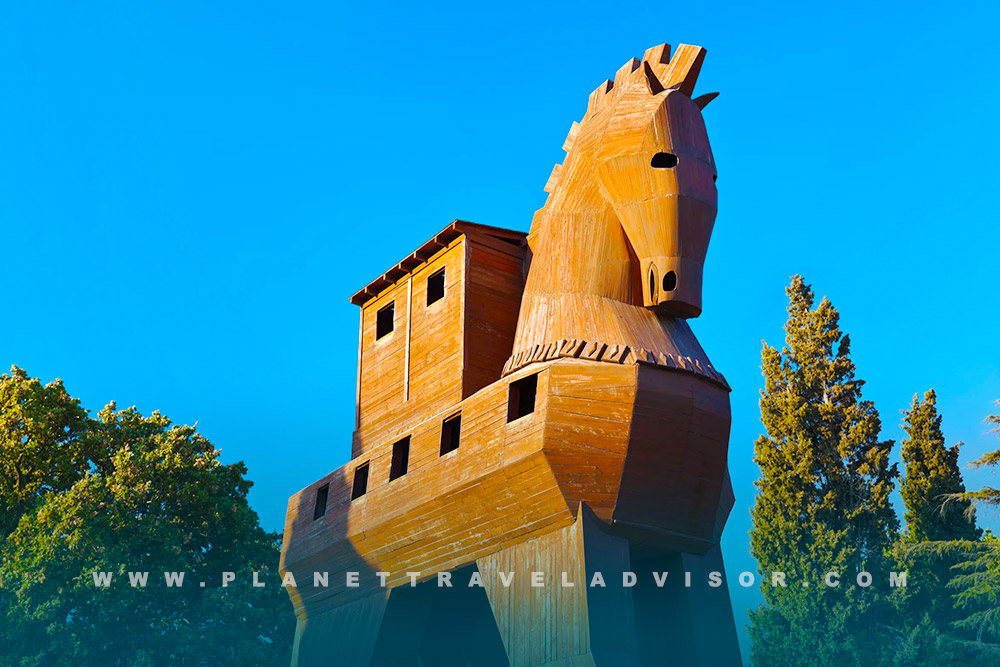
The ruins of ancient Troy stand at Hisarlık in Türkiye’s Çanakkale Province. The site, with more than 4,000 years of history and multiple city layers, is recognized as a UNESCO World Heritage property, an acknowledgment not only of Troy’s importance in epic tradition but also of its archaeological significance linking Anatolian and Mediterranean civilizations.
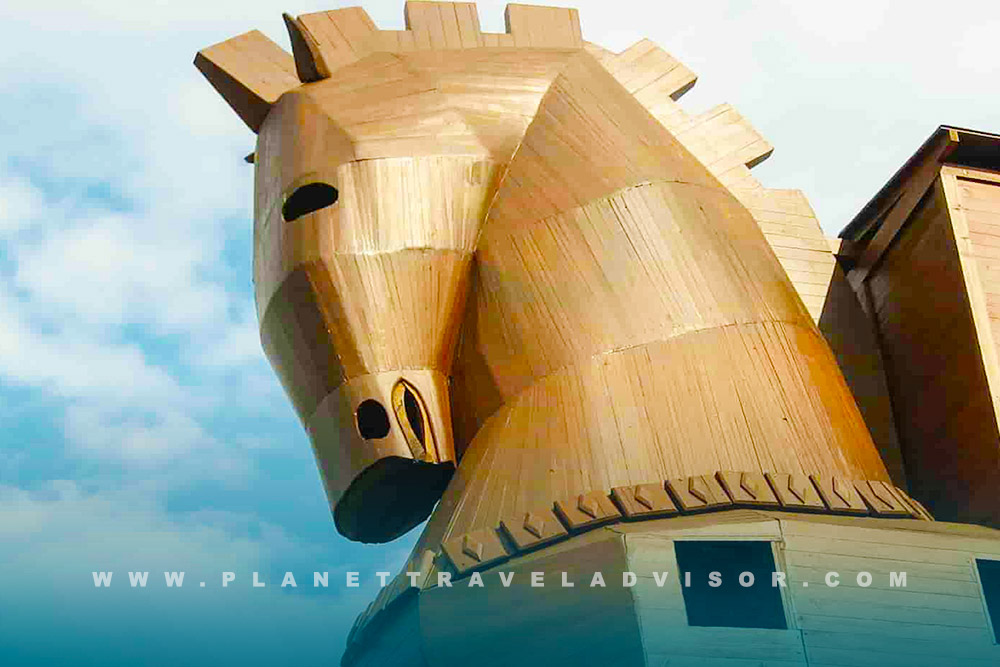
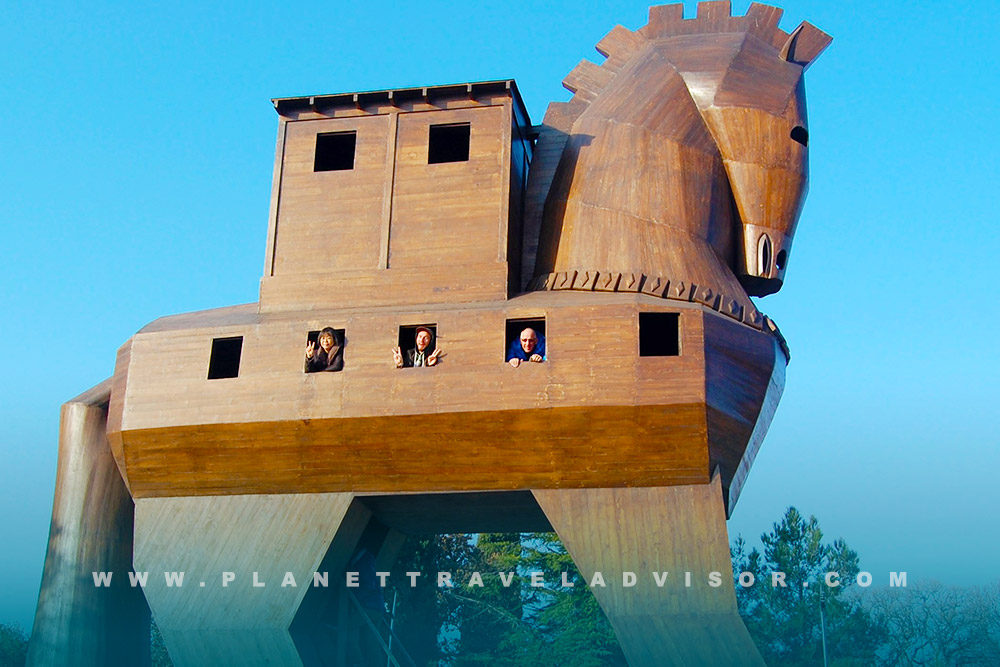
Near the entrance to the ruins, you’ll encounter a large wooden Replica of a Trojan Horse. This monument, designed to give visitors a tangible, walk-in sense of the legend, was built in the 1970s. Turkish Archaeological News reports that architect İzzet Senemoğlu created the current wooden model in 1975, using pine from nearby Mount Ida (Kaz Dağı). It rises roughly 12.5 meters and, by design, allows visitors to climb inside and peer out from small windows toward the site.
Contemporary Turkish news coverage has occasionally noted restoration work and slightly different height figures over the decades, but the essential facts remain consistent: the Replica of a Trojan Horse at the site is a climb-inside, pinewood landmark positioned to welcome you into the ruins and spark your imagination as you step through millennia of history. If you’re planning the visit, pair the ruins with the excellent Trojan Museum (opened nearby in 2018) to see artifacts that contextualize the epic in real material culture. For official, current details on the site and its layers, refer to the Turkish Museums portal and UNESCO’s listing, both of which keep authoritative overviews.
Down on the Dardanelles, Çanakkale’s seafront hosts another famous Replica of a Trojan Horse, the cinematic prop from Wolfgang Petersen’s 2004 film Troy. Following the film’s release, the horse was gifted to the city and installed on the waterfront promenade, where it quickly became an emblem beloved by locals and visitors alike. Reporting at the time highlighted that the figure is a fiberglass movie prop weighing about 12 tonnes, a flashy “gift horse” attracting crowds and global press attention to the region.
Local tourism information notes that this waterfront Replica of a Trojan Horse stands approximately 12.4 meters tall, with a steel frame clad in fiberglass, and has been exhibited in the city center since 13 September 2004. The combination of cinematic glamor and seaside setting makes it one of the most photographed spots in town.
Travel editors have echoed the appeal; Lonely Planet, for instance, points out how the 2004 movie boosted visitor numbers to the region and left Çanakkale with its distinctive horse on the promenade, a handy landmark on a relaxed walk from the ferry terminal.
So, did a wooden horse roll through Troy’s gates? The most defensible answer is: probably not as described. Archaeologists have established multiple destruction layers at the site and clear evidence of a major Late Bronze Age city, but no artifact that we could identify as a horse. Rather, historians and classicists often interpret the story metaphorically or as a poetic retelling of siege tactics. D’Angour’s hypothesis, for example, suggests the horse motif may echo the look of ancient siege engines armored in hides. The legend’s persistence, however, speaks to its explanatory power for audiences across time.
Meanwhile, archaeology anchors the narrative to a place you can walk today. UNESCO’s dossier and official summaries emphasize Troy’s 4,000-year span and the site’s role as a bridge between Anatolia and the Mediterranean. Whether you stand beneath the timber at the gate or the fiberglass on the seafront, a Replica of a Trojan Horse condenses that long conversation between text and trench into a single, photogenic silhouette.
When you visit both the site and the city, you’ll notice that each Replica of a Trojan Horse has a different personality, one earthy and tactile, the other theatrical and imposing. Here’s how they compare at a glance, and why the differences matter:
These choices reflect two aims. At Hisarlık, the Replica of a Trojan Horse is an educational invitation, part lookout, part storytelling device set against the archaeological horizon. In Çanakkale, the prop works as a pop-culture beacon, reminding you that ancient tales keep reinventing themselves for new audiences.
Think of Troy and Çanakkale as a matched set: one site for ruins and a hands-on wooden model, one small city for amenities, and a starry film prop. To get the most out of both Replica of a Trojan Horse experiences, consider the following:
Slow down at each replica and notice details you might otherwise miss. At Hisarlık, the Replica of a Trojan Horse includes simple wood joinery and small windows; it’s intentionally tactile, slightly rough, and photogenic against the windswept plateau.
On the seafront, look for the visible bolts and panels that betray the cinematic build beneath; the horse’s posture and angular lines were meant to command a wide camera frame and a busy skyline. The Guardian’s contemporary dispatch called it a 12-tonne fiberglass star, still accurate when you stand at its hooves today.
At the end of the article, you can discover the soul of Türkiye on journeys crafted for travelers who crave both wonder and ease. Wander vibrant streets lined with spice-scented stalls, drift above Cappadocia’s dreamlike valleys in a hot air balloon, and walk through the timeless columns of Ephesus. Every detail is curated for effortless travel and genuine local encounters. Reserve your spot now to enjoy exclusive offers and early access to our most-loved Turkey trips in 2026. Your next chapter of culture, history, and comfort is ready to begin.



A curated list of the most popular travel packages based on different destinations.
Discover the top things to do in Turkey in 2026, from historical sites to natural wonders. With so much to explore, there is something for everyone.
The best time to visit Turkey 2026 depends on what you're looking for. Read more about when to go to Turkey 2026
Plan your perfect Istanbul trip with our guide! Discover top attractions, local cuisine, and tips for an unforgettable adventure in this vibrant city.
Get the ultimate Istanbul packing list for your 2026 trip. From clothes to essentials, be fully prepared for a memorable visit to Turkey’s vibrant city.
Discover the worst seasons to visit Konya. Learn what to expect year-round and get tips to plan your trip and enjoy Konya’s culture and history wisely.
Discover top tips for visiting Konya, Turkey! Get advice on culture, safety, attractions, and food for an unforgettable experience in this historic city.
Get ready for Konya with our packing guide covering essentials, toiletries, tech, and smart tips for a smooth and culture-rich travel experience.
Plan a perfect visit to the Göreme Open Air Museum in Cappadocia, learn its history, top cave churches, and frescoes, 2026 ticket prices, hours & expert tips.
Cavusin Village in Cappadocia blends early-Christian cave churches, Red & Rose Valley hikes, and sunrise balloons. Plan when to go, what to see, and how.
Plan your dream trip to Hierapolis with our expert guide covering history, travertines, seasons, costs, transport, hot springs, tips and FAQs for 2025.
Monks Valley travel guide: six expert tips on timing, tickets, transport, photos, and monk history to make your Cappadocia visit effortless and unforgettable.
Uncover Kaymakli Underground City's layered history, ingenious design, and key visitor tips, and experience Cappadocia's most intriguing subterranean wonder.
We go beyond just booking trips—we create unforgettable travel experiences that match your dreams!


One of the smoothest tours we have ever booked. We booked the "7 Days Cappadocia, Konya, Antalya, Pamukkale & Ephesus Tour" package and were impressed by how professionally everything was arranged. The itinerary gave us enough time to enjoy Cappadocia, Ephesus, Pamukkale, Antalya, and Konya without feeling rushed, and all transfers and day tours ran on time. The communication before arrival was clear and helpful, which made planning much easier. What we appreciated most was the balance between guided sightseeing and free time, so the whole trip felt comfortable and enjoyable. If you are looking for a reliable way to explore Turkey, this is a great option. It was the perfect mix of sightseeing, comfort, and great logistics.
Everything about this package felt thoughtfully planned. We booked the "4 Days Gallipoli, Troy, Pergamum, Ephesus & Pamukkale Tour" package and were impressed by how professionally everything was arranged. The itinerary gave us enough time to enjoy Ephesus, Pamukkale, Gallipoli, Troy, and Pergamum without feeling rushed, and all transfers and day tours ran on time. The communication before arrival was clear and helpful, which made planning much easier. What we appreciated most was the balance between guided sightseeing and free time, so the whole trip felt comfortable and enjoyable. If you are looking for a reliable way to explore Turkey, this is a great option. The guides, transfers, and pacing all worked together perfectly.
This trip exceeded all our expectations. We booked the "8 Days Real Taste of Vietnam Tour" package and were impressed by how professionally everything was arranged. The itinerary gave us enough time to enjoy Vietnam without feeling rushed, and all transfers and day tours ran on time. The communication before arrival was clear and helpful, which made planning much easier. What we appreciated most was the balance between guided sightseeing and free time, so the whole trip felt comfortable and enjoyable. If you are looking for a reliable way to explore Vietnam, this is a great option. We would absolutely recommend it to anyone visiting this destination.
One of the smoothest tours we have ever booked. We booked the "Petra Day Tour from Amman in Jordan" package and were impressed by how professionally everything was arranged. The itinerary gave us enough time to enjoy Petra, Amman, and Jordan without feeling rushed, and all transfers and day tours ran on time. The communication before arrival was clear and helpful, which made planning much easier. What we appreciated most was the balance between guided sightseeing and free time, so the whole trip felt comfortable and enjoyable. If you are looking for a reliable way to explore Jordan, this is a great option. It was the perfect mix of sightseeing, comfort, and great logistics.
We loved how easy and enjoyable this entire experience was. We booked the "14 Days Hanoi Hue Hoi An Mekong Saigon Tour" package and were impressed by how professionally everything was arranged. The itinerary gave us enough time to enjoy Hanoi, Saigon, Hoi An, the Mekong, and Hue without feeling rushed, and all transfers and day tours ran on time. The communication before arrival was clear and helpful, which made planning much easier. What we appreciated most was the balance between guided sightseeing and free time, so the whole trip felt comfortable and enjoyable. If you are looking for a reliable way to explore Vietnam, this is a great option. We came home with amazing memories and would book again.










Comments (02)
Mr. Bowmik Haldar,
05 June, 2024Outstanding News & Insight! Thank you so much for sharing like this article
Jacoline Juie,
05 June, 2023However, here are some well-regarded car dealerships known for their customer service, inventory, and overall reputation. It's always a good idea to research and read reviews specific...
Leave Your Comment: