 Visit Turkey
 Visit Vietnam
 Visit Cambodia
 Visit Dubai
 Visit Jordan


Amman Guide 2026 - Things to Do and Visitor Tips
Plan your trip with this Amman travel guide covering top sights, food, neighborhoods, transport, day trips, where to stay, and practical visitor tips.



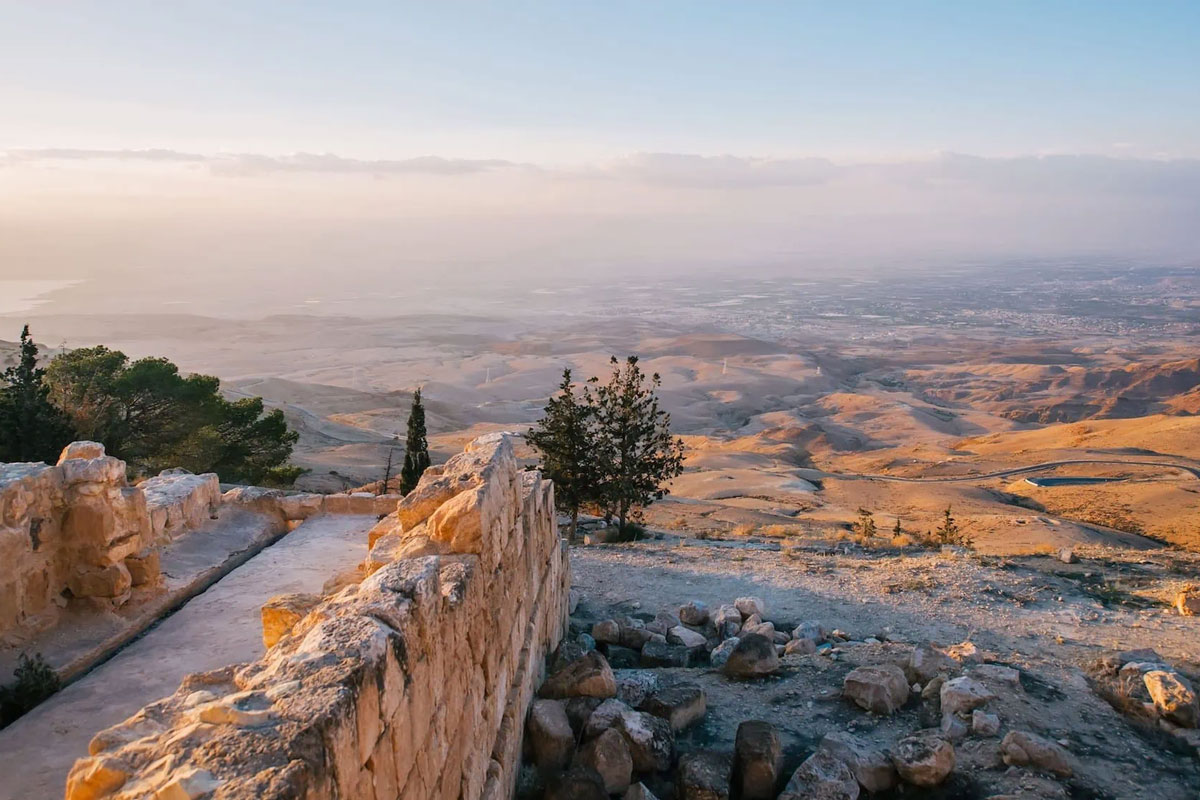
Mount Nebo is one of Jordan's most important biblical landmarks, traditionally identified as the mountain where Moses viewed the Promised Land before his death. Located near Madaba, the site combines religious history, early Christian archaeology, and panoramic views across the Jordan Valley and Dead Sea.
Visitors can explore the Memorial Church of Moses, examine centuries-old Byzantine mosaics, and stand at a viewpoint connected with one of the Bible's most significant stories. This guide explains Mount Nebo's history, its principal attractions, entrance fees, opening hours, and how to include it in a journey through Jordan.
Mount Nebo is best known for its connection to Moses and the final events of his life, as described in the Old Testament.
According to Deuteronomy 34:1–4, Moses climbed from the plains of Moab to the summit of Pisgah, where God showed him the land promised to the Israelites.
The biblical account describes a panorama extending across several regions, including Gilead, Naphtali, Ephraim, Manasseh, Judah, and the area surrounding Jericho.
Although Moses was permitted to see the Promised Land, he was told that he would not cross into it.
Deuteronomy 34:5–6 then describes his death in the land of Moab and burial in a valley opposite Beth-peor. Importantly, the biblical text states that the location of his grave was unknown.
For this reason, Mount Nebo is traditionally associated with Moses' final days, but there is no verified archaeological identification of his burial place.
The distinction is important because the mountain's religious significance comes primarily from biblical tradition rather than physical evidence establishing the precise location of Moses' death.
The broader mountain area contains several elevations. The principal pilgrimage sanctuary stands on Ras Siyagha, traditionally associated with Mount Pisgah, while the higher summit of Jebel an-Neba reaches approximately 802 meters above sea level.
This landscape has attracted Christian pilgrims for centuries.
By the late fourth century AD, early Christian communities had established a memorial sanctuary honoring Moses. Over time, it developed into a substantial religious complex that continued to attract pilgrims from across the region.
Mount Nebo also has importance in Jewish tradition because of its connection with Moses and the conclusion of the Israelites' wilderness journey. Moses, known as Musa in Islam, is likewise revered as a major prophet, although religious traditions should not be confused with archaeological evidence about this particular site.
Today, Mount Nebo remains a meaningful destination for pilgrims and travelers interested in understanding the historical geography of the biblical world.
Mount Nebo is a relatively compact archaeological and religious site, but several monuments help visitors understand its significance.
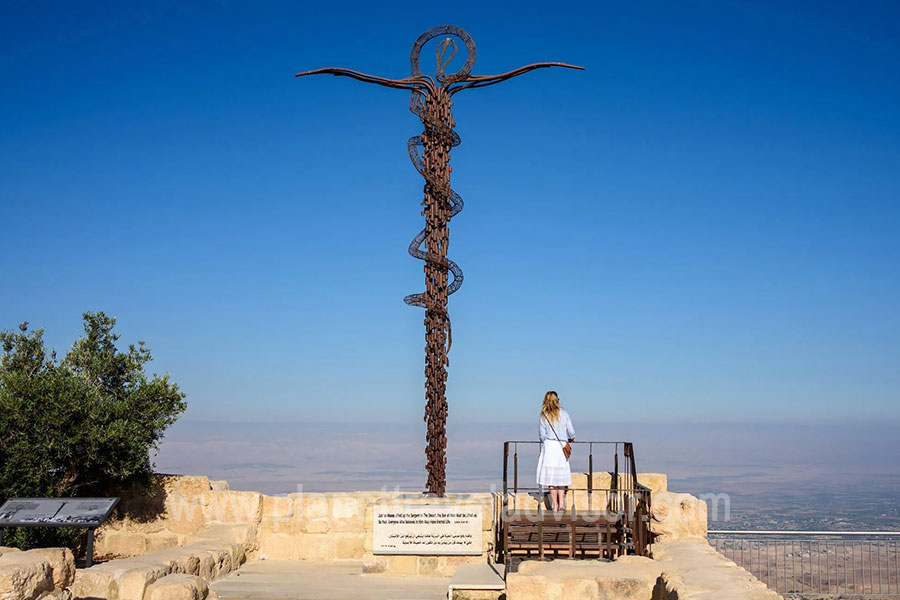
The most recognizable outdoor landmark is the Serpentine Cross, a tall metal sculpture standing near the panoramic viewpoint.
Created by Italian artist Gian Paolo Fantoni in the 1980s, the monument combines two important biblical symbols.
The serpent represents the bronze serpent that Moses raised in the wilderness, as described in Numbers 21:4–9. The cross represents the crucifixion of Jesus Christ and the connection made to this earlier story in the Gospel of John.
The sculpture has become one of Mount Nebo's most photographed features, particularly when viewed against the open landscape.
Another important monument commemorates the visit of Pope John Paul II in March 2000.
During his pilgrimage to the Holy Land, the Pope visited Mount Nebo, reinforcing its importance as a destination for Christian pilgrimage and religious reflection.
A commemorative stone near the entrance recalls this historic occasion and includes religious inscriptions in different languages.
Visitors can also explore the archaeological remains surrounding the Memorial Church.
These include ancient stone foundations, architectural fragments, and evidence of buildings that once formed part of the Byzantine monastery complex.
A small museum area presents archaeological objects and information about the site's historical development, including pottery fragments and other discoveries associated with the surrounding region.
The outdoor areas provide opportunities to appreciate the mountain's setting, observe the preserved remains, and understand why this location held religious importance for successive generations.
Even travelers without a particular religious connection may find Mount Nebo interesting for its archaeology, early Christian art, and relationship with the historical landscape of Jordan.
The Memorial Church of Moses is the most important historical structure at Mount Nebo and one of the main reasons to visit the site.
The original Christian sanctuary developed during the fourth century AD, when a small memorial building was established near the location traditionally associated with Moses.
Over the following centuries, the complex underwent several expansions and renovations.
During the Byzantine period, the original sanctuary developed into a larger basilica with additional chapels, baptisteries, and buildings connected with the surrounding monastery.
Archaeological excavations have revealed several phases of construction, demonstrating the site's importance to early Christian communities.
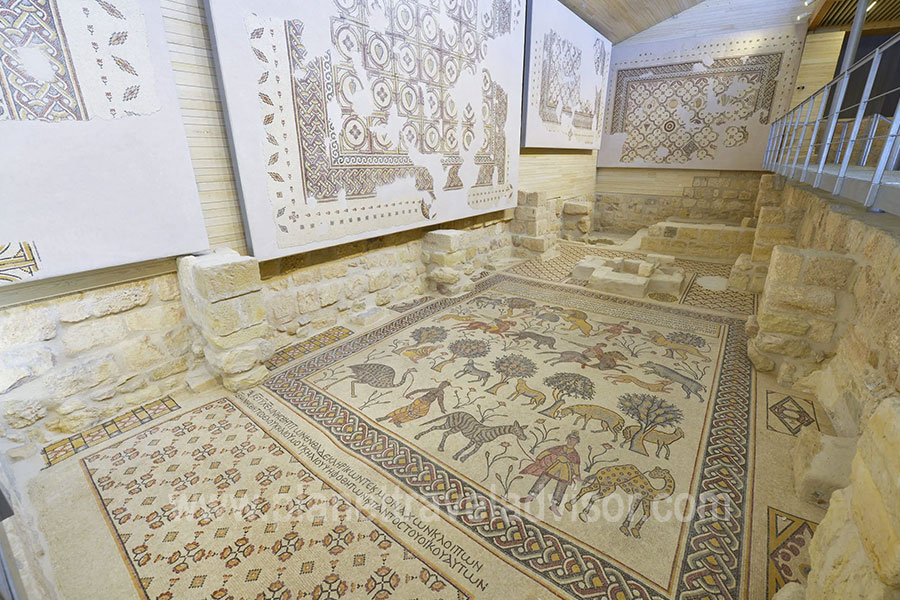
The surviving mosaic floors are among its most valuable artistic features.
One particularly remarkable mosaic dates to AD 531 and was originally associated with a baptistery.
Its elaborate designs depict animals, hunting activities, and pastoral scenes, offering insight into artistic traditions and aspects of everyday life in the Byzantine world.
Among the recognizable figures are hunters, shepherds, domesticated animals, and exotic wildlife.
Rather than concentrating exclusively on religious symbols, these images combine decorative patterns with scenes of human activity and the natural world.
This makes them especially interesting for visitors who want to understand how Byzantine artists represented their surroundings.
An inscription associated with the mosaic records the names of religious authorities and craftsmen connected with its creation.
Such inscriptions provide valuable evidence about the people responsible for decorating religious buildings during this period.
The church also preserves other mosaic fragments featuring geometric patterns, crosses, and decorative compositions from different stages of the sanctuary's development.
Some mosaic floors were discovered beneath later layers, revealing how successive generations modified and expanded the building.
The archaeological complex is now protected by a reconstructed basilica, completed in 2016.
This modern structure was designed to preserve the ancient remains while allowing visitors to examine the mosaics and architectural features.
Inside, travelers can observe the relationship between the surviving Byzantine foundations, columns, chapels, and carefully conserved mosaic floors.
The Memorial Church remains a religious sanctuary as well as an archaeological destination.
Visitors should therefore respect its spiritual character, avoid touching the ancient mosaics, and follow any instructions concerning photography or restricted areas.
Taking time to examine the mosaics closely often reveals details that are easy to overlook during a short visit.
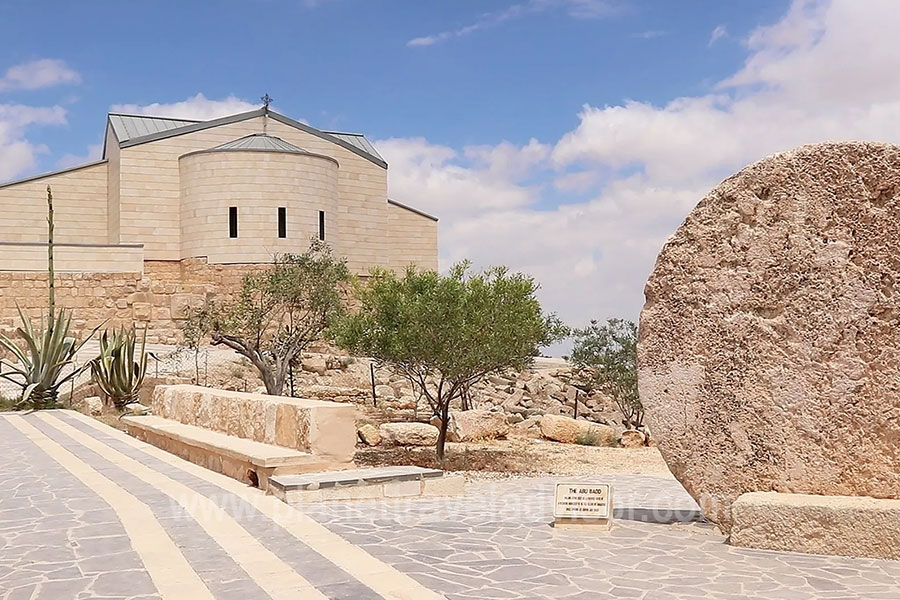
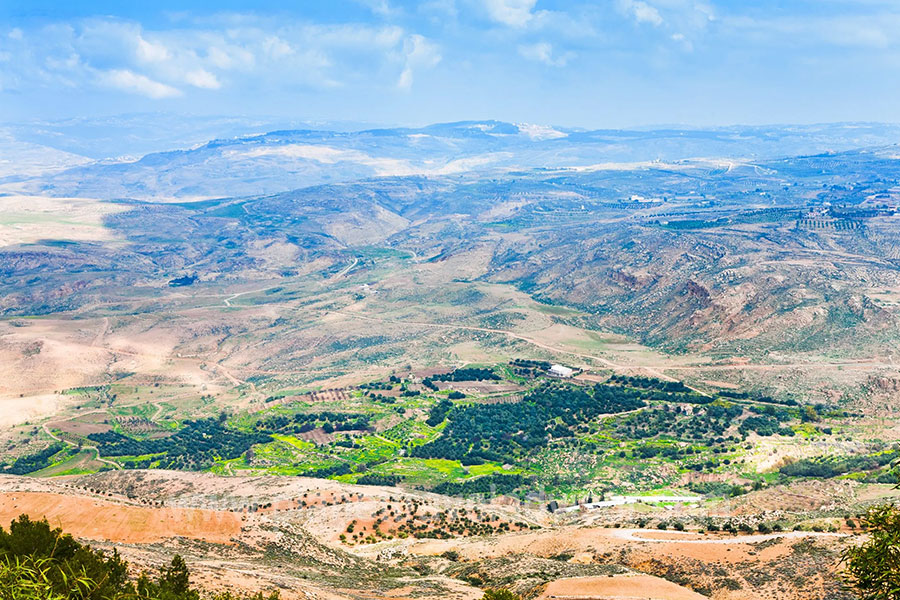
The Mount Nebo viewpoint is one of the site's most memorable features, offering an extensive panorama across the surrounding landscape.
From Ras Siyagha, visitors can look westward over the Jordan Valley toward the Dead Sea and the hills beyond the Jordan River.
On clear days, it may be possible to identify the region around Jericho and more distant locations associated with the biblical landscape.
Some descriptions of Mount Nebo suggest that Jerusalem can be seen from the summit.
Although distant views toward Jerusalem are possible under exceptionally clear atmospheric conditions, visitors should not assume that the city will be visible during an ordinary visit.
Dust, haze, humidity, and seasonal weather can significantly reduce visibility, particularly during warmer months.
The panoramic view is also different from the biblical description of the lands shown to Moses, which carries religious meaning beyond what modern visitors can physically identify.
For photography, clear mornings can be especially rewarding because atmospheric haze may be less pronounced before the day becomes warmer.
Late-afternoon light can also create attractive colors across the mountain slopes, although visitors must plan around the site's closing time.
Spring and autumn are generally comfortable seasons for exploring Mount Nebo.
From March to May, temperatures are often suitable for outdoor sightseeing, and the surrounding landscape may appear greener after winter rainfall.
September to November can also offer pleasant conditions, particularly as the intense summer heat begins to ease.
During summer, high temperatures and strong sunlight can make exposed viewing areas uncomfortable, even though the developed site does not require a long mountain hike.
Winter visits are possible, but travelers should prepare for colder conditions, wind, and occasional rain.
For most visitors, the best strategy is to arrive in the morning, explore the church before the site becomes busier, and spend time at the viewpoint while visibility is favorable.
Comfortable walking shoes, sun protection, and an additional clothing layer during cooler months can make the visit more enjoyable.
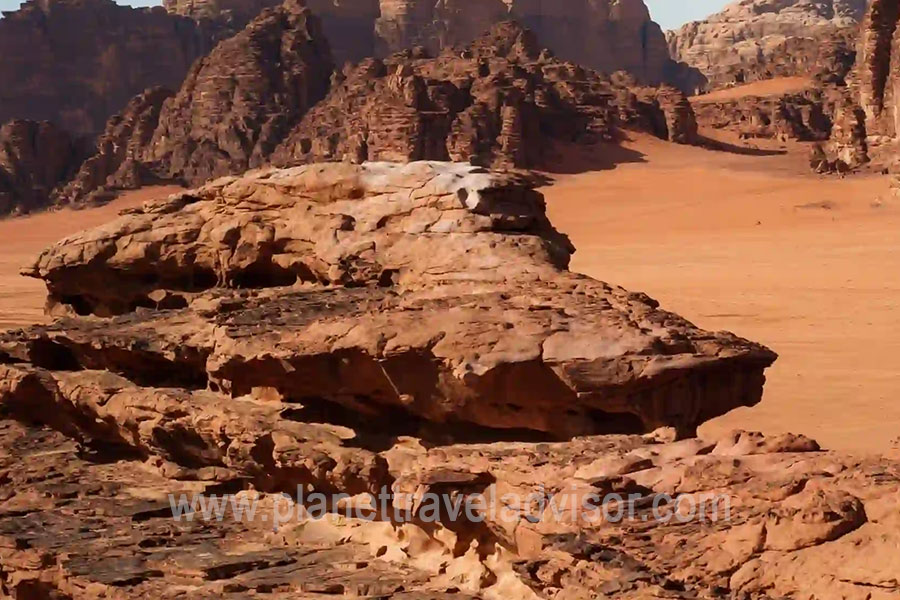
Mount Nebo is located approximately 8–10 kilometers northwest of Madaba, making it one of the easiest historical attractions to combine with sightseeing in the city.
The drive from central Madaba generally takes around 10–20 minutes, depending on the starting point and traffic conditions.
From Amman, Mount Nebo is approximately 35–45 kilometers away by road, with typical driving times of around 45–60 minutes. The precise distance and travel time depend on where you begin in the capital.
The most convenient ways to reach the site are by private car, taxi, or organized excursion.
Travelers renting a vehicle can follow the roads toward Madaba and continue to the Mount Nebo visitor area.
The mountain is accessible by road, and visitor parking is available near the sanctuary.
A taxi from Madaba is another practical option, especially for travelers staying in the city without a rental car.
Because the visit is relatively short, it may be convenient to arrange a return journey with the same driver.
Agree on the total fare, waiting time, and pickup location before departure rather than assuming the driver will remain at the site.
Public transportation is less convenient for visitors seeking a straightforward sightseeing trip. Services connecting Amman and Madaba may be available, but onward transportation to the sanctuary and return schedules should be checked in advance.
For visitors who prefer not to coordinate transfers independently, organized Jordan vacations can make it easier to combine Mount Nebo with Madaba, the Dead Sea, and other destinations.
How much time should you allow at Mount Nebo?
Most visitors can explore the principal attractions in approximately 45–90 minutes.
A shorter visit may be sufficient for viewing the Serpentine Cross, entering the Memorial Church, and taking photographs from the viewpoint.
Travelers with a particular interest in religious history, archaeology, or Byzantine mosaics may prefer to spend closer to 90 minutes.
The developed visitor area involves much less walking than an archaeological destination such as Petra.
However, some pathways are sloped, and certain sections may have uneven surfaces or steps.
Visitors with reduced mobility should confirm current accessible routes and any assistance they may need before arriving.
Mount Nebo has a separate entrance fee for visitors wishing to explore the Memorial Church and the archaeological sanctuary.
According to the published site information available in October 2026, the standard entrance fee for international visitors is 3 Jordanian dinars (JOD).
The published local admission rate is 0.5 JOD, although eligibility for reduced rates should be confirmed when purchasing tickets.
Current published visitor information:
| Visitor information | Details |
|---|---|
| International entrance fee | 3 JOD |
| Published local admission fee | 0.5 JOD |
| Opening hours | 8:00 AM–5:00 PM |
| Opening days | Daily |
| Recommended visit duration | 45–90 minutes |
| Main attractions | Memorial Church, mosaics, Serpentine Cross, panoramic viewpoint |
Mount Nebo's Jordan Pass eligibility requires particular attention.
The official Jordan Pass biblical itinerary identifies Mount Nebo as an attraction for which separate admission is required, while the broader Jordan Pass attractions directory also lists the site. Because these official listings are inconsistent, travelers should confirm current coverage directly before visiting and be prepared to purchase a separate ticket.
Opening hours may also change because of religious events, maintenance, or operational requirements.
Visitors planning to arrive late in the afternoon should verify the final admission arrangements rather than assuming that entry is permitted until the published closing time.
As Mount Nebo remains a religious site, respectful behavior is expected.
Visitors should dress appropriately for entering the Memorial Church, speak quietly inside the sanctuary, and follow any posted rules.
Photography may be permitted in designated areas, but visitors should check for restrictions before photographing religious activities or delicate archaeological exhibits.
The site includes developed walkways and visitor facilities, although some sections have slopes or uneven surfaces.
Travelers using wheelchairs or mobility aids may require assistance on steeper approaches.
It is also advisable to bring drinking water, wear comfortable shoes, and carry sun protection when exploring outdoor areas.
Combining Mount Nebo with Madaba is one of the most practical ways to experience Jordan's early Christian heritage in a single excursion.
The two destinations are only a short drive apart, and both feature historically significant mosaics connected with the Byzantine period.
Madaba is particularly famous for the sixth-century Madaba Mosaic Map, preserved inside St. George's Greek Orthodox Church.
The surviving floor mosaic depicts parts of the ancient Holy Land, including Jerusalem and other important geographical locations.
Unlike the decorative mosaics at Mount Nebo, the Madaba Map provides a historical representation of places, roads, and settlements known during the Byzantine period.
Visiting both sites therefore allows travelers to appreciate two different forms of mosaic art: religious and geographical imagery in Madaba, and decorative and narrative compositions at Mount Nebo.
For a comfortable half-day excursion from Amman, consider the following schedule:
Morning departure from Amman: Travel toward Madaba before sightseeing traffic becomes heavier.
Explore Madaba: Visit St. George's Church and examine the famous mosaic map. Allow additional time for the old town if desired.
Continue to Mount Nebo: Drive approximately 10–20 minutes to the sanctuary.
Visit the Memorial Church: Examine the Byzantine mosaics and archaeological remains.
Enjoy the viewpoint: Spend time observing the Jordan Valley and surrounding landscape before returning to Amman.
This itinerary generally works well as a half-day outing, particularly when transportation is arranged in advance.
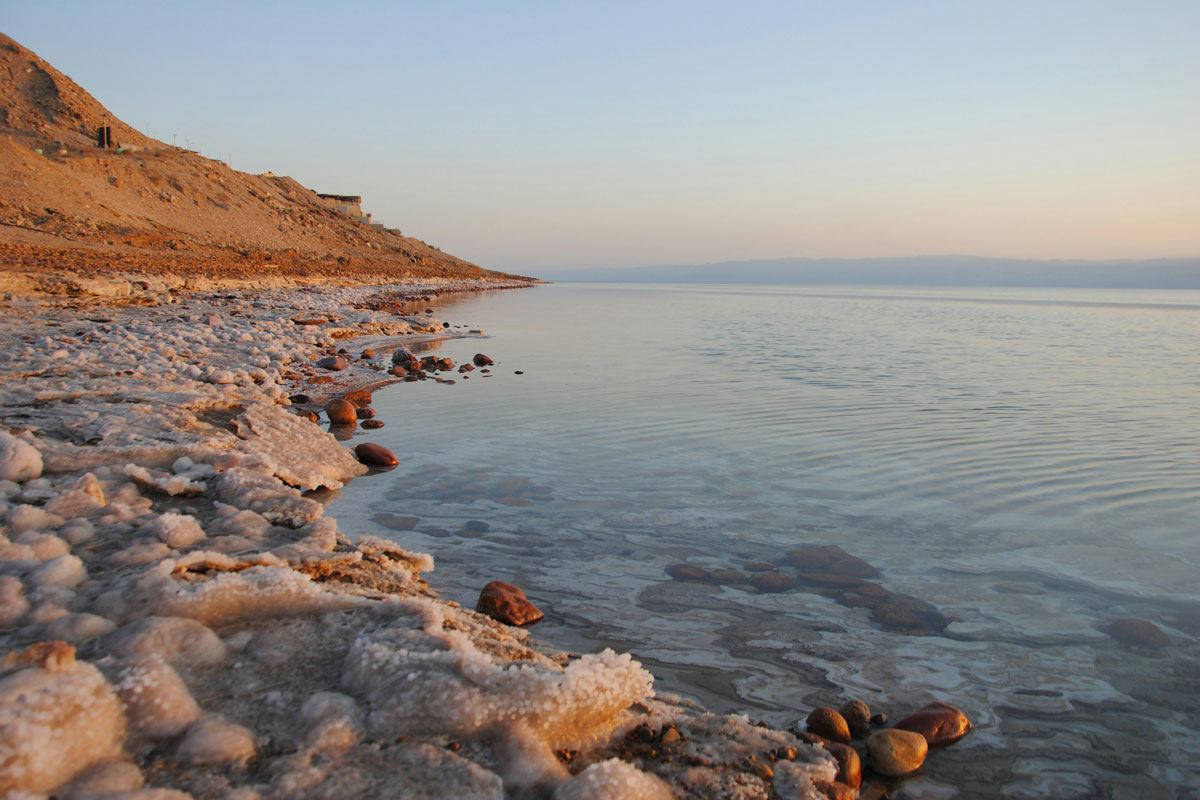
Travelers with a full day available may consider continuing toward the Dead Sea.
The Dead Sea provides a contrasting experience, combining distinctive natural scenery with opportunities for relaxation at designated resort or beach facilities.
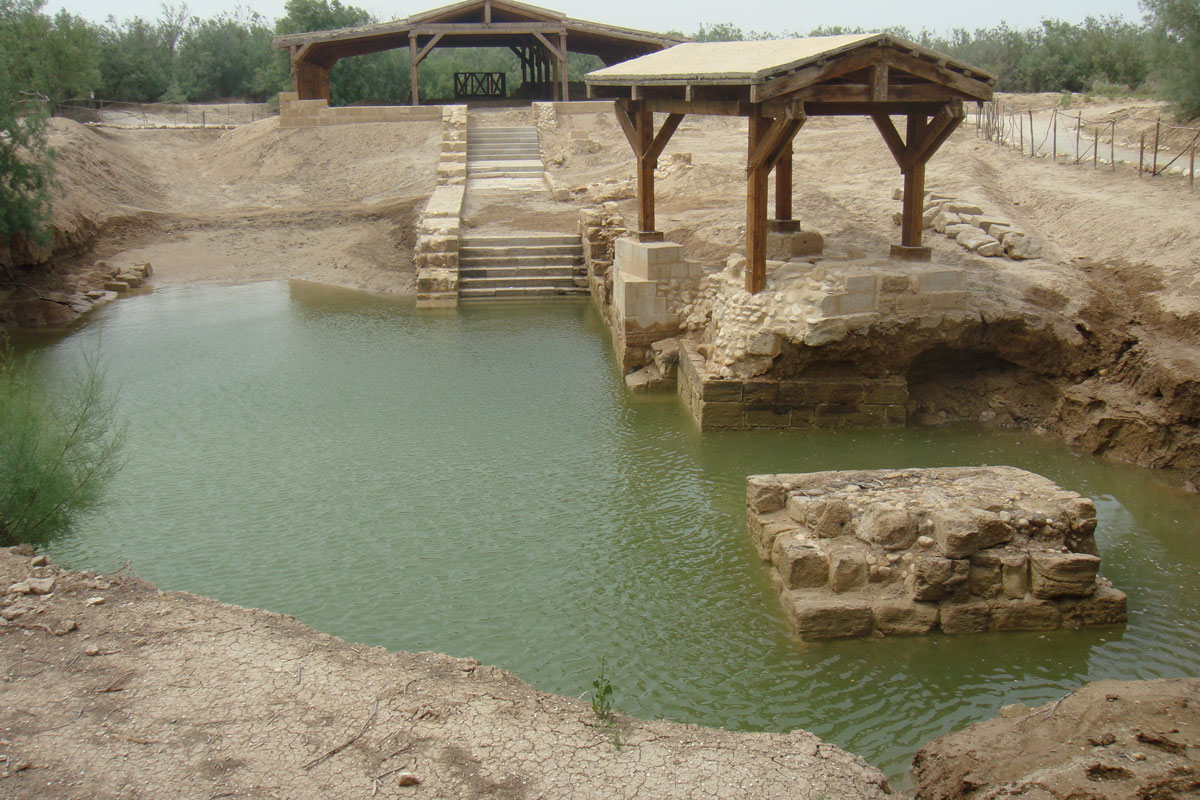
Another possible addition is Bethany Beyond the Jordan, traditionally associated with the baptism of Jesus Christ.
However, including Madaba, Mount Nebo, Bethany, and the Dead Sea in a single day requires careful scheduling, especially because individual attractions have separate opening hours and visiting procedures.
Travelers who prefer a relaxed pace may find it better to divide these destinations across two days.
For a longer itinerary, Mount Nebo can also be included between Amman and destinations farther south, such as Petra.
The most suitable combination depends on your interests, available time, and how much sightseeing you want to fit into each day.
Mount Nebo offers a meaningful combination of biblical history, Byzantine archaeology, and panoramic scenery overlooking the Jordan Valley. Its connection with Moses gives the mountain lasting religious significance, while the Memorial Church and ancient mosaics provide a tangible record of Jordan's early Christian heritage.
The site is relatively easy to visit and works particularly well alongside Madaba's famous mosaic attractions. For travelers with more time, the Dead Sea and other historical destinations can extend the experience.
If you are planning a wider journey through Jordan, book Jordan tours to connect Mount Nebo with the country's other important cultural and historical sites.
A curated list of the most popular travel packages based on different destinations.
Plan your trip with this Amman travel guide covering top sights, food, neighborhoods, transport, day trips, where to stay, and practical visitor tips.
Plan your Amman Roman Theatre visit with current ticket prices, opening hours, Jordan Pass details, history, nearby sights, and practical travel tips.
Explore the best souqs in Amman, from Al-Balad and the Gold Souq to Souq Jara, with shopping tips, souvenirs, timing, and nearby sights.
Explore Siq Petra, its Nabataean water system, ancient carvings, Treasury walk, history, opening hours, tickets, photography tips, and visitor advice.
Explore Amman Citadel with practical tips on history, top sights, tickets, opening hours, Jordan Pass access, timing, transport, and nearby attractions.
Explore the Jordan Archaeological Museum in Amman, including top artifacts, tickets, Jordan Pass, opening hours, Citadel tips, and visitor advice.
Plan your visit to the Baptism Site in Jordan with its biblical history, archaeology, tickets, opening hours, Jordan Pass details, and nearby stops.
Plan your Dead Sea Jordan visit with tips on floating, beaches, resorts, transport, best times, safety, nearby attractions, and how long to stay.
Explore Downtown Amman with tips on the Roman Theatre, souks, local food, walking routes, the Citadel, safety, transport, and the best time to visit.
Plan your visit to Hadrian’s Arch Jerash with its history, architecture, tickets, opening hours, Jordan Pass details, nearby sites, and travel tips.
Plan your first visit to Jerash Jordan with the best ruins to see, walking route, tickets, Jordan Pass details, opening hours, timing, and travel tips.
Explore the best Jordan Valley attractions and things to do, from ancient Pella and the Jordan River to the Dead Sea, with practical tips for planning your visit.
We go beyond just booking trips—we create unforgettable travel experiences that match your dreams!


One of the smoothest tours we have ever booked. We booked the "6 Days Classic Vietnam Tour Package" package and were impressed by how professionally everything was arranged. The itinerary gave us enough time to enjoy Vietnam without feeling rushed, and all transfers and day tours ran on time. The communication before arrival was clear and helpful, which made planning much easier. What we appreciated most was the balance between guided sightseeing and free time, so the whole trip felt comfortable and enjoyable. If you are looking for a reliable way to explore Vietnam, this is a great option. It was the perfect mix of sightseeing, comfort, and great logistics.
This trip exceeded all our expectations. We booked the "3 Day Cappadocia and Ephesus Tour by Air" package and were impressed by how professionally everything was arranged. The itinerary gave us enough time to enjoy Cappadocia and Ephesus without feeling rushed, and all transfers and day tours ran on time. The communication before arrival was clear and helpful, which made planning much easier. What we appreciated most was the balance between guided sightseeing and free time, so the whole trip felt comfortable and enjoyable. If you are looking for a reliable way to explore Turkey, this is a great option. We would absolutely recommend it to anyone visiting this destination.
Everything about this package felt thoughtfully planned. We booked the "6 Days Exploring Istanbul Cappadocia and Pamukkale" package and were impressed by how professionally everything was arranged. The itinerary gave us enough time to enjoy Istanbul, Cappadocia, and Pamukkale without feeling rushed, and all transfers and day tours ran on time. The communication before arrival was clear and helpful, which made planning much easier. What we appreciated most was the balance between guided sightseeing and free time, so the whole trip felt comfortable and enjoyable. If you are looking for a reliable way to explore Turkey, this is a great option. The guides, transfers, and pacing all worked together perfectly.
One of the smoothest tours we have ever booked. We booked the "9 Days Angkor and Mekong Expeditions Package" package and were impressed by how professionally everything was arranged. The itinerary gave us enough time to enjoy the Mekong and Angkor without feeling rushed, and all transfers and day tours ran on time. The communication before arrival was clear and helpful, which made planning much easier. What we appreciated most was the balance between guided sightseeing and free time, so the whole trip felt comfortable and enjoyable. If you are looking for a reliable way to explore Vietnam, this is a great option. It was the perfect mix of sightseeing, comfort, and great logistics.
A beautifully organized journey from start to finish. We booked the "8 Days Hoi An Beach Escape and Culture Tour" package and were impressed by how professionally everything was arranged. The itinerary gave us enough time to enjoy Hoi An without feeling rushed, and all transfers and day tours ran on time. The communication before arrival was clear and helpful, which made planning much easier. What we appreciated most was the balance between guided sightseeing and free time, so the whole trip felt comfortable and enjoyable. If you are looking for a reliable way to explore Vietnam, this is a great option. The itinerary was well balanced and never felt rushed.










Comments (02)
Mr. Bowmik Haldar,
05 June, 2024Outstanding News & Insight! Thank you so much for sharing like this article
Jacoline Juie,
05 June, 2023However, here are some well-regarded car dealerships known for their customer service, inventory, and overall reputation. It's always a good idea to research and read reviews specific...
Leave Your Comment: