 Visit Turkey
 Visit Vietnam
 Visit Cambodia
 Visit Dubai
 Visit Jordan


Siq Petra Guide for First-Time Visitors
Explore Siq Petra, its Nabataean water system, ancient carvings, Treasury walk, history, opening hours, tickets, photography tips, and visitor advice.



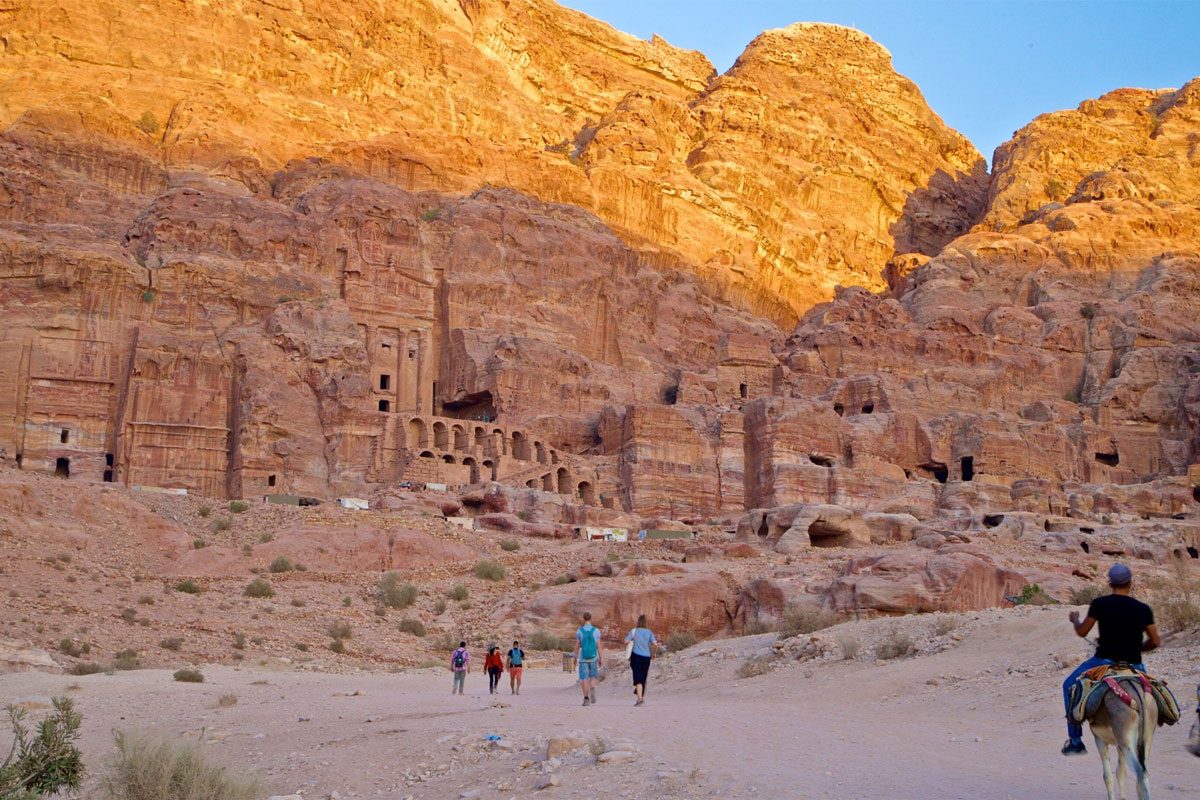
The Royal Tombs Petra are among the most impressive monuments left by the Nabataeans, the ancient civilization that transformed Petra into a major trading city. Carved directly into the sandstone cliffs of Jabal Al-Khubtha, these four monumental tombs overlook the ruins of the ancient city and reveal the architectural ambition of its wealthy inhabitants.
Unlike the famous Treasury, which stands alone at the end of the Siq, the Royal Tombs form a striking group of adjoining façades. Each has its own architectural features, historical significance, and relationship with Petra's extraordinary landscape.
Visitors can explore the Urn Tomb, Silk Tomb, Corinthian Tomb, and Palace Tomb while learning about Nabataean burial traditions, ancient engineering, and the city's later Byzantine history. Understanding how to reach the tombs, when to visit, and how much time to allow will help you appreciate these monuments without rushing through them.
Location: Western slope of Jabal Al-Khubtha, Petra, Jordan.
Civilization: Nabataean Kingdom.
Historical period: Principally the first century AD, with some construction possibly extending into the early second century.
Main monuments: Urn Tomb, Silk Tomb, Corinthian Tomb, and Palace Tomb.
Original purpose: Monumental funerary structures, probably associated with prominent or wealthy families.
Most notable later use: The Urn Tomb was converted into a Byzantine church in AD 447.
UNESCO status: Part of the Petra World Heritage Site, inscribed in 1985.
Admission: Included in the standard Petra Archaeological Park entrance ticket.
The history of Petra's Royal Tombs is closely connected with the rise of the Nabataean Kingdom. The Nabataeans developed Petra into a prosperous commercial center by controlling important caravan routes connecting Arabia, Egypt, and the Mediterranean world. Their trading wealth supported elaborate temples, public buildings, and monumental tombs carved into the surrounding mountains.
Most of the four principal Royal Tombs were constructed during the first century AD, when Petra was a powerful regional capital. Their impressive façades combine architectural traditions from the Hellenistic world with local Nabataean design and funerary customs.
The tombs were carved into the western face of Jabal Al-Khubtha, overlooking the ancient city's inhabited areas. This prominent position was probably deliberate. Rather than concealing their dead in isolated cemeteries, the Nabataeans created monumental burial structures that remained visible within the urban landscape.
Their name reflects the exceptional size, decoration, and location of the monuments. Archaeologists generally associate them with the Nabataean elite, and some may have been intended for rulers or members of prominent families.
However, no surviving inscriptions securely identify the original occupants of the four principal tombs. Individual associations with particular kings remain hypotheses rather than established historical facts.
The architecture provides stronger evidence of their importance. Monumental columns, decorative capitals, pediments, and carefully carved entrances demonstrate considerable technical skill and financial resources.
The Nabataean builders also adapted their designs to the natural sandstone cliffs. Instead of assembling every façade from separate building blocks, craftsmen removed stone directly from the mountainside, shaping columns, architectural details, entrances, and burial chambers from the rock itself.
This technique helped create the remarkable integration between architecture and landscape that characterizes Petra.
One particularly important fact is that the tombs were not all identical in purpose or subsequent use. The Urn Tomb eventually became a Christian church, while the Palace Tomb may also have accommodated ceremonies associated with the dead.
Another interesting detail concerns their names. The Silk Tomb was named for its colorful stone, the Corinthian Tomb for its classical capitals, and the Palace Tomb for its resemblance to monumental palace architecture. These names describe visible features rather than identifying their original occupants.
Together, the Royal Tombs illustrate how the Nabataeans adapted Mediterranean architectural styles to their own cultural and religious traditions.
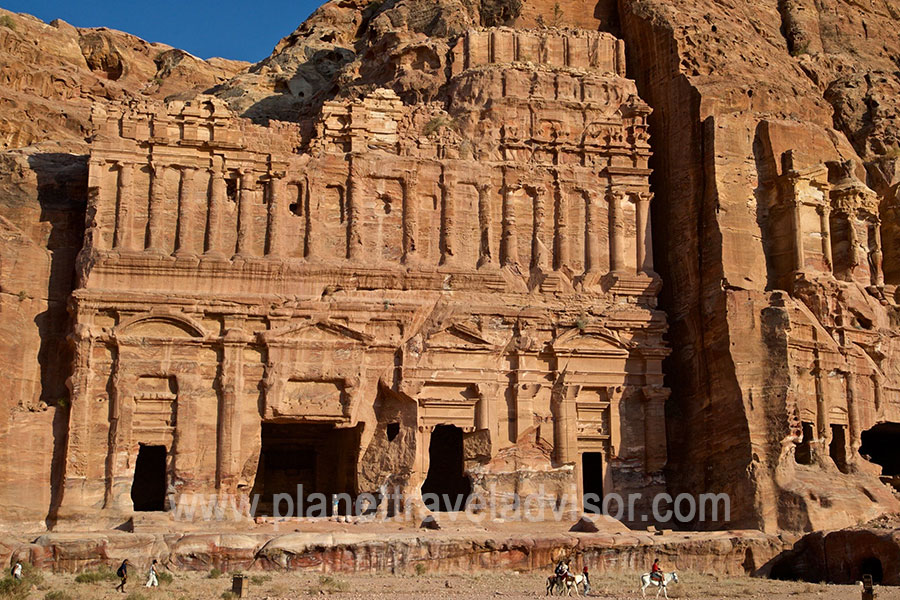
The four principal monuments stand along the same sandstone cliff, but each deserves individual attention. From right to left when viewing the group from the valley, they are the Urn Tomb, Silk Tomb, Corinthian Tomb, and Palace Tomb.
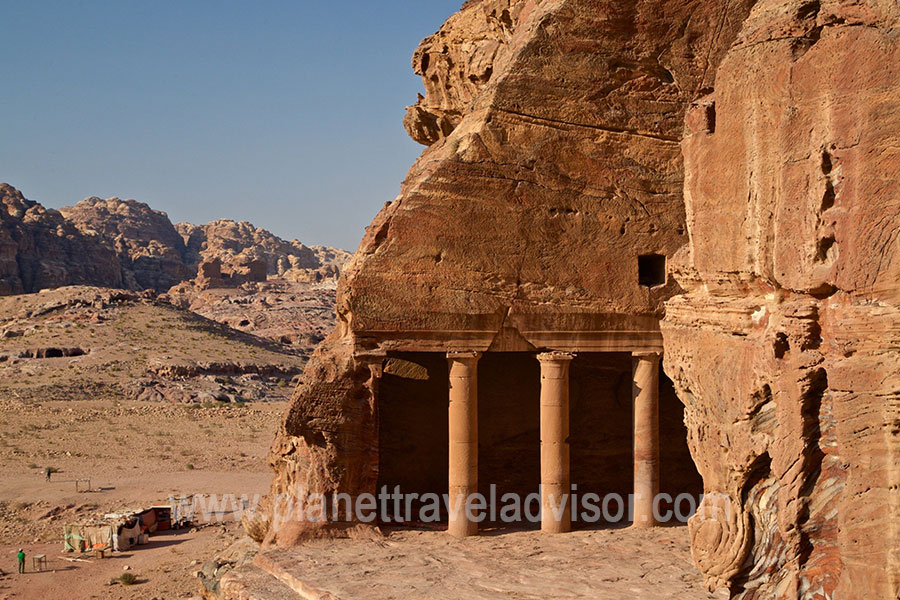
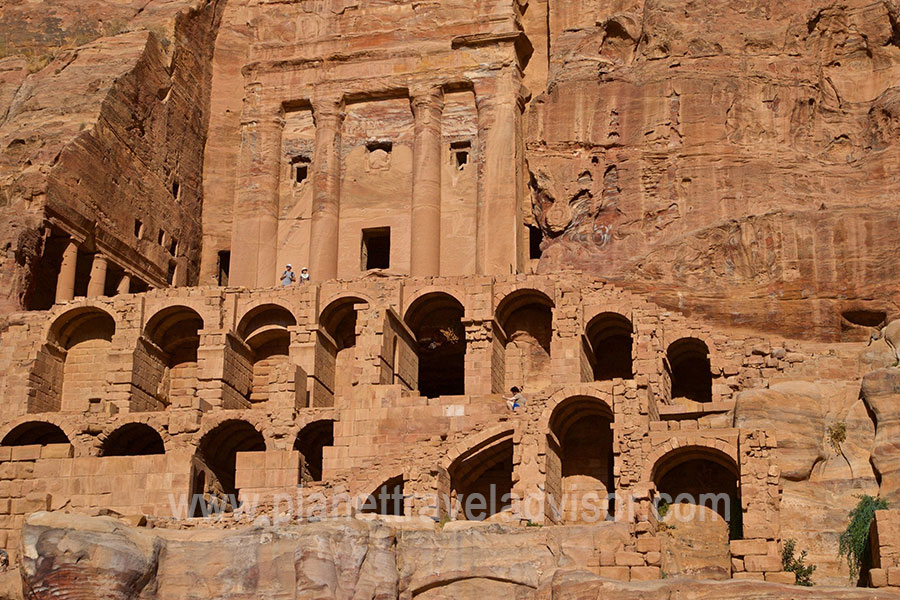
The Urn Tomb is one of the most recognizable monuments in the group. Its elevated position, broad courtyard, monumental staircase, and arched substructure give it an imposing appearance above the valley.
Its name comes from the urn-shaped decoration crowning the façade. The monument is generally dated to the first half of the first century AD.
The façade features engaged columns and decorative niches, while the interior contains a large rectangular chamber measuring approximately 18.95 by 17.15 meters.
What makes the Urn Tomb especially significant is its later transformation.
A Greek inscription records that Bishop Jason converted the structure into a Christian church in AD 447. Three apses were carved into the interior during its adaptation for religious use, demonstrating how Petra's Nabataean monuments acquired new functions during the Byzantine period.
Local Bedouin traditions also gave the monument names such as Al-Mahkama, meaning the Court, because of beliefs concerning the function of its chambers and vaults.
For visitors, the Urn Tomb offers an opportunity to observe the transition between Nabataean funerary architecture and Byzantine religious history within a single monument.
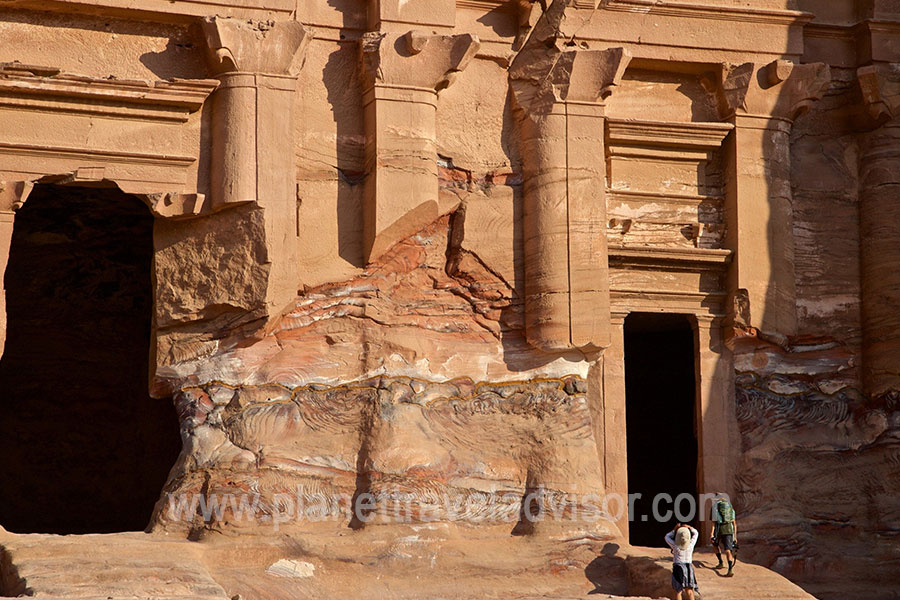
The Silk Tomb is the smallest of the four main Royal Tombs, but its colorful sandstone makes it one of the most visually distinctive.
Its façade measures approximately 10.8 meters wide and 19 meters high. Rather than being famous for monumental scale, it attracts attention through its natural bands of red, pink, yellow, white, brown, and orange stone.
These swirling layers create a surface that resembles flowing silk, giving the monument its modern name.
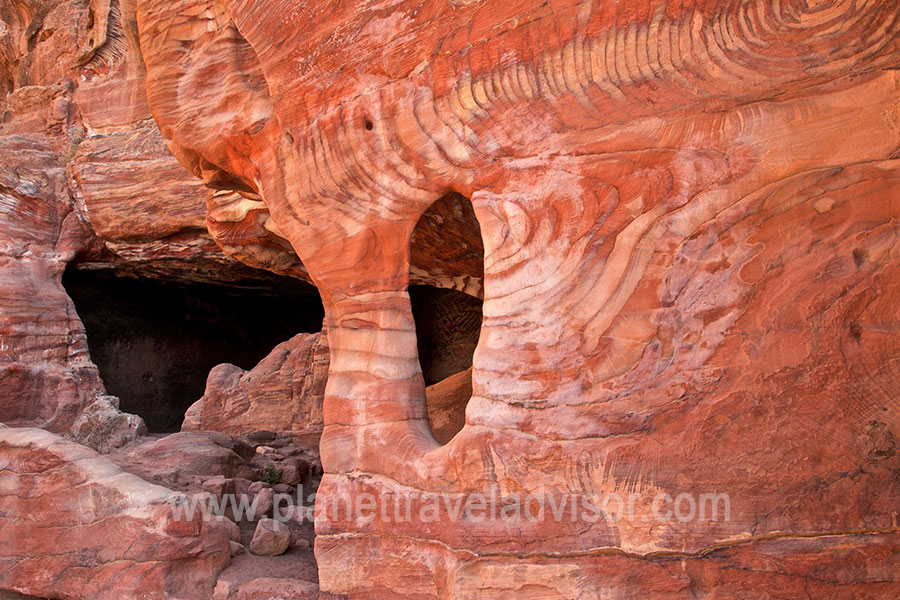
The colors are part of the natural sandstone geology rather than artificial paint or surviving ancient decoration. Different mineral compositions within the rock produce the striking variations visible across the façade.
Architecturally, the tomb contains pilasters and a burial recess, or loculus, positioned high in the rock face. The monument is generally dated to the first half of the first century AD.
The Silk Tomb is particularly interesting for photographers because its colors and textures can appear noticeably different as the sunlight changes throughout the day.
The Corinthian Tomb stands beside the Silk Tomb and is distinguished by its elaborate classical façade.
French traveler Léon de Laborde gave the monument its modern name in 1828 because of the Corinthian-style capitals decorating its upper level.
The façade measures approximately 27.55 meters wide and 28 meters high. It consists of three architectural levels, with the upper section showing a resemblance to Petra's famous Treasury.
The lower level includes eight half-columns, while the upper composition incorporates additional columns and decorative elements.
Although much of its architectural detailing has suffered from centuries of erosion, the surviving structure still reveals the influence of Hellenistic design on Nabataean craftsmanship.
Inside are four chambers containing recesses associated with the monument's funerary use.
The Corinthian Tomb provides a useful comparison with the Treasury because both monuments employ classical architectural forms, even though their layouts and surviving decorative details differ.
The Palace Tomb is the largest and most elaborate of the four principal Royal Tombs.
Its monumental façade measures approximately 49 meters wide and 46 meters high, creating an appearance reminiscent of a multistory palace.
The structure consists of five architectural levels. Its lowest level contains five doorways, several framed by columns and topped with triangular or semicircular pediments.
Four internal chambers are accessible through the entrances, with a passage connecting the two central chambers.
Above them, the second level contains a series of 18 columns supporting the upper architectural composition. Parts of the monument were built using individual stone blocks where the natural cliff did not provide sufficient material.
The Palace Tomb is generally dated to the late first century or early second century AD.
Archaeologists have suggested that the monument may have supported funerary ceremonies or gatherings, although its complete original function remains uncertain.
Its enormous scale makes it an important example of Nabataean architectural ambition and the close relationship between Petra's buildings and its natural sandstone landscape.
The Royal Tombs are located along the eastern side of Petra's central archaeological area, beyond the Treasury and near the ancient Theatre.
Most visitors reach them by following Petra's main walking route from the Visitor Center.
After entering through the Siq and passing the Treasury, continue toward the Street of Facades and the Theatre. The Royal Tombs become visible on the hillside overlooking the valley.
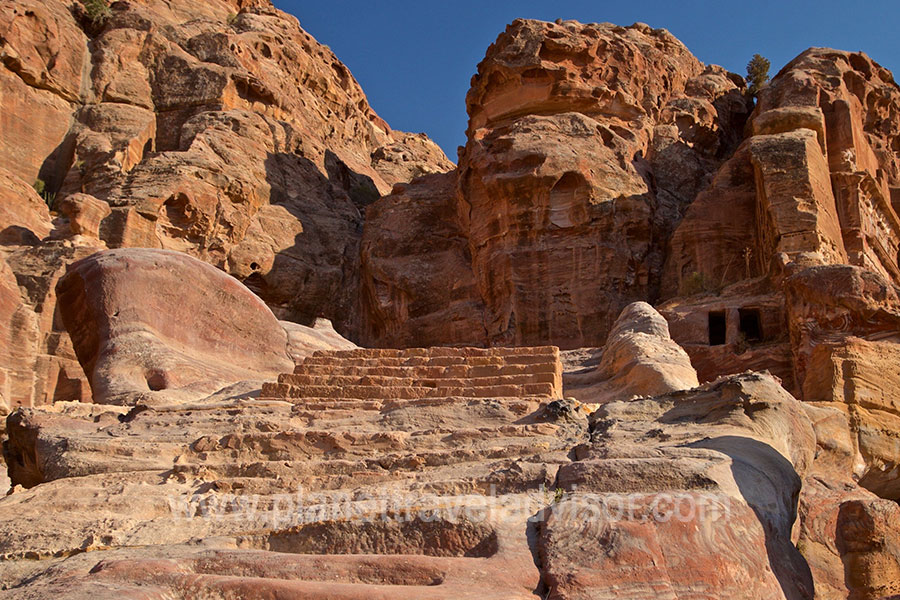
Beyond the Theatre, turn toward the stairs leading up to the Urn Tomb. The official Al-Khubtha Trail description identifies the staircase near the restroom area beyond the Theatre as the approach to the tombs.
The route includes uneven archaeological pathways and stone steps, so sturdy walking shoes are recommended. The climb to the elevated tombs requires more physical effort than simply viewing their façades from the valley.
Allow approximately 45–90 minutes to explore the four principal tombs once you reach the area, depending on your interests, walking pace, and access restrictions.
This estimate covers the tomb complex itself, not the entire walk from Petra's Visitor Center.
Visitors interested in architecture and photography may appreciate additional time, particularly around the Urn Tomb's elevated terrace and the Palace Tomb's monumental façade.
The Al-Khubtha Trail continues beyond the Royal Tombs toward an elevated viewpoint overlooking the Treasury.
It is a separate, more demanding experience than simply visiting the four tomb façades.
The official Petra Tourism Development Region Authority classifies the full Al-Khubtha route from the Visitor Center as difficult, with an estimated duration of four to five hours. The published guided-trail information also describes a shorter Al-Khubtha segment beginning near the Royal Tombs.
The route involves extensive stair climbing, rocky paths, exposed sections, and substantial elevation changes.
The reward is an elevated view of the Treasury and its surrounding sandstone cliffs, which provides a perspective very different from the familiar ground-level viewpoint.
For travelers with limited time or mobility, visiting the Royal Tombs without completing the entire Al-Khubtha hike is a reasonable choice.
Those considering the longer trail should verify its current status with the Petra Visitor Center, start early, carry sufficient water, and avoid attempting the route during extreme heat or unfavorable weather.
For visitors planning Petra alongside other Jordanian destinations, exploring available Jordan tour itineraries can help identify itineraries with enough time for archaeological sightseeing and optional hiking.
The Royal Tombs are part of Petra Archaeological Park, so visitors do not normally need a separate admission ticket to see them.
Access is covered by the standard Petra entrance ticket or an eligible Jordan Pass.
According to the official Petra tourism website, the published admission prices for international visitors staying overnight in Jordan are:
One-day ticket: 50 JOD.
Two-day ticket: 55 JOD.
Three-day ticket: 60 JOD.
A separate 90 JOD one-day admission category applies to non-accommodated visitors who do not stay overnight in Jordan.
These prices were checked in October 2026 and may be updated by the tourism authorities. Two-day and three-day tickets must be used on consecutive days.
Children under 12 receive complimentary daytime admission under the published Petra ticket conditions.
Visitors should carry a valid passport because identification is required at the ticket office.
Yes. Since the Royal Tombs are located inside Petra Archaeological Park, their general admission is included in the Petra access provided by a valid Jordan Pass.
The official Jordan Pass currently offers three main options:
Jordan Wanderer: 70 JOD, including one day at Petra.
Jordan Explorer: 75 JOD, including two consecutive days at Petra.
Jordan Expert: 80 JOD, including three consecutive days at Petra.
Eligible travelers may also benefit from waived tourist visa fees if they meet the pass's conditions, including purchasing it before arrival and staying in Jordan for at least two nights.
The Jordan Pass does not include every optional visitor service, private guide, or special event.
The official Petra tourism authority publishes seasonal operating schedules.
For the winter period from October 2, 2026, through March 1, 2027, Petra Archaeological Park and its Visitor Center are scheduled to open from 6:30 AM to 5:00 PM.
The preceding summer schedule, from March 2 through October 1, 2026, was 6:00 AM to 6:00 PM.
Opening hours may change during special circumstances, so visitors should confirm the latest schedule before traveling.
Some tomb chambers and terraces may be accessible to visitors, but access can change depending on conservation work, safety assessments, and site management decisions.
Follow signs and instructions at each monument. Never climb restricted sections of a façade or enter a chamber that has been closed.
The sandstone is vulnerable to erosion and physical damage, making responsible visitor behavior especially important.
Facilities are more readily available along Petra's main visitor route than on elevated hiking paths. Carry water, wear sun protection, and use designated rest areas before continuing toward the tombs or higher trails.
The best time to visit Petra's Royal Tombs depends on weather, available daylight, and whether you plan to photograph the façades or continue hiking.
Spring and autumn generally provide more comfortable temperatures for walking around Petra's exposed archaeological landscape.
Spring, from March to May, often brings pleasant daytime conditions, although temperatures and weather can vary considerably.
Autumn, from September to November, is another suitable period, particularly for travelers who want to explore the tombs and surrounding archaeological sites on foot.
Summer temperatures can be high, making early starts particularly important. Winter brings cooler weather and occasional rainfall, which can create slippery paths and hazardous conditions in some parts of Petra.
The Royal Tombs face west, so afternoon sunlight can illuminate their monumental sandstone façades particularly well.
This makes the latter part of the day attractive for photographing the Urn Tomb, Corinthian Tomb, and Palace Tomb from permitted viewpoints across the valley.
The Silk Tomb is especially rewarding when changing light brings out the natural bands and mineral colors in its sandstone.
Morning visits may be more comfortable for walking during warmer months, even though the direct lighting on the façades may be less favorable.
Several perspectives are worth considering:
The main valley offers broad views of the four Royal Tombs together.
The Urn Tomb's approach and permitted terrace areas provide closer views of its monumental façade and surrounding ruins.
The area near the Silk Tomb allows detailed photographs of the colorful sandstone.
The approach to the Palace Tomb provides opportunities to appreciate the scale of its architectural design.
The Al-Khubtha Trail offers higher views over Petra, with the Treasury viewpoint as its principal photographic attraction.
Visitors should remain on approved routes and avoid unstable ledges or restricted archaeological surfaces.
For the best experience, plan your final photographs with enough time to return through the main visitor route before the park closes.
The Royal Tombs of Petra represent some of the finest surviving examples of Nabataean funerary architecture. Their monumental façades, distinctive sandstone colors, and historical transformations reveal how ancient Petra combined artistic expression, religious traditions, and remarkable engineering.
The most rewarding visit is one that gives each of the four tombs enough attention without rushing toward the next attraction. Consider the walking conditions, check current access arrangements, and decide in advance whether to include the more demanding Al-Khubtha Trail.
Travelers planning a broader cultural journey can explore Jordan tours and choose an itinerary that combines Petra's archaeological highlights with other historical landscapes throughout the country.



A curated list of the most popular travel packages based on different destinations.
Explore Siq Petra, its Nabataean water system, ancient carvings, Treasury walk, history, opening hours, tickets, photography tips, and visitor advice.
Plan your trip with this Amman travel guide covering top sights, food, neighborhoods, transport, day trips, where to stay, and practical visitor tips.
Explore Amman Citadel with practical tips on history, top sights, tickets, opening hours, Jordan Pass access, timing, transport, and nearby attractions.
Plan your Amman Roman Theatre visit with current ticket prices, opening hours, Jordan Pass details, history, nearby sights, and practical travel tips.
Explore the best souqs in Amman, from Al-Balad and the Gold Souq to Souq Jara, with shopping tips, souvenirs, timing, and nearby sights.
Explore the Jordan Archaeological Museum in Amman, including top artifacts, tickets, Jordan Pass, opening hours, Citadel tips, and visitor advice.
Plan your visit to the Baptism Site in Jordan with its biblical history, archaeology, tickets, opening hours, Jordan Pass details, and nearby stops.
Plan your Dead Sea Jordan visit with tips on floating, beaches, resorts, transport, best times, safety, nearby attractions, and how long to stay.
Explore Downtown Amman with tips on the Roman Theatre, souks, local food, walking routes, the Citadel, safety, transport, and the best time to visit.
Plan your visit to Hadrian’s Arch Jerash with its history, architecture, tickets, opening hours, Jordan Pass details, nearby sites, and travel tips.
Plan your first visit to Jerash Jordan with the best ruins to see, walking route, tickets, Jordan Pass details, opening hours, timing, and travel tips.
Explore the Jordan River's biblical history, where Jesus was baptized, how to visit from Amman, and the best nearby places to include on your Jordan trip.
We go beyond just booking trips—we create unforgettable travel experiences that match your dreams!



This trip exceeded all our expectations. We booked the "10 Days in Turkey Tour Itinerary" package and were impressed by how professionally everything was arranged. The itinerary gave us enough time to enjoy the main highlights without feeling rushed, and all transfers and day tours ran on time. The communication before arrival was clear and helpful, which made planning much easier. What we appreciated most was the balance between guided sightseeing and free time, so the whole trip felt comfortable and enjoyable. If you are looking for a reliable way to explore Turkey, this is a great option. We would absolutely recommend it to anyone visiting this destination.
This trip exceeded all our expectations. We booked the "8 Days Cappadocia, Ephesus, Pamukkale, Fethiye & Antalya Tour" package and were impressed by how professionally everything was arranged. The itinerary gave us enough time to enjoy Cappadocia, Ephesus, Pamukkale, and Antalya without feeling rushed, and all transfers and day tours ran on time. The communication before arrival was clear and helpful, which made planning much easier. What we appreciated most was the balance between guided sightseeing and free time, so the whole trip felt comfortable and enjoyable. If you are looking for a reliable way to explore Turkey, this is a great option. We would absolutely recommend it to anyone visiting this destination.
A beautifully organized journey from start to finish. We booked the "Explore Turkey in 9 Days from Ephesus to Cappadocia" package and were impressed by how professionally everything was arranged. The itinerary gave us enough time to enjoy Cappadocia and Ephesus without feeling rushed, and all transfers and day tours ran on time. The communication before arrival was clear and helpful, which made planning much easier. What we appreciated most was the balance between guided sightseeing and free time, so the whole trip felt comfortable and enjoyable. If you are looking for a reliable way to explore Turkey, this is a great option. The itinerary was well balanced and never felt rushed.
One of the smoothest tours we have ever booked. We booked the "9 Days Angkor and Mekong Expeditions Package" package and were impressed by how professionally everything was arranged. The itinerary gave us enough time to enjoy the Mekong and Angkor without feeling rushed, and all transfers and day tours ran on time. The communication before arrival was clear and helpful, which made planning much easier. What we appreciated most was the balance between guided sightseeing and free time, so the whole trip felt comfortable and enjoyable. If you are looking for a reliable way to explore Vietnam, this is a great option. It was the perfect mix of sightseeing, comfort, and great logistics.
We loved how easy and enjoyable this entire experience was. We booked the "8 Days Gallipoli, Pergamum, Pamukkale, Ephesus & Cappadocia Tour" package and were impressed by how professionally everything was arranged. The itinerary gave us enough time to enjoy Cappadocia, Ephesus, Pamukkale, Gallipoli, and Pergamum without feeling rushed, and all transfers and day tours ran on time. The communication before arrival was clear and helpful, which made planning much easier. What we appreciated most was the balance between guided sightseeing and free time, so the whole trip felt comfortable and enjoyable. If you are looking for a reliable way to explore Turkey, this is a great option. We came home with amazing memories and would book again.











Comments (02)
Mr. Bowmik Haldar,
05 June, 2024Outstanding News & Insight! Thank you so much for sharing like this article
Jacoline Juie,
05 June, 2023However, here are some well-regarded car dealerships known for their customer service, inventory, and overall reputation. It's always a good idea to research and read reviews specific...
Leave Your Comment: